
ESP32 LTE & Cellular Industrial Controllers
Four NORVI product families carry a cellular modem on board. Together they cover 4G LTE, LTE-M, and NB-IoT, with 2G fallback built in. Each is an ESP32 industrial IoT controller made to report from any site, without touching the customer's network.
Why Cellular for Industrial ESP32 Controllers
Industrial sites rarely give you the network you need. IT departments guard the plant LAN. Wi-Fi doesn't reach the pump house. And a machine shipped to a customer's site can't depend on whatever network is already there.
A cellular modem built into the controller ends that need. The device carries its own connection. That's the idea behind every cellular product NORVI makes. Each ESP32 industrial IoT controller works the day it's turned on, on any site, without touching the customer's network.
NORVI GSM and NORVI X sit inside the broader NORVI ESP32 PLC lineup for panel-powered automation. If there's no grid power at the site at all, skip ahead to the battery-powered EC-M12 instead.
The OEM pattern: machine builders who ship to customer sites often choose an ESP32 industrial IoT controller from NORVI. The reason is simple: it works without depending on the buyer's network. It reports over its own connection. That gives them remote monitoring and early failure signals on every machine they ship, with no extra hardware.
The NORVI Cellular Lineup
Four form factors, one design principle. Match the row below to your deployment before reading the detail sections.
| Device | Form factor | Power | Cellular role | Choose it when… |
|---|---|---|---|---|
| NORVI GSM | DIN-rail controller, built-in I/O | 9-32V DC panel power | Modem built into the PLC | You're automating or collecting data in a panel and want the controller itself online, with no separate gateway box. |
| NORVI X | Modular DIN-rail PLC, cellular CPU variants | 24V DC panel power | Cellular on the CPU + Ethernet, RS-485, Wi-Fi, Bluetooth standard | You need expandable I/O and multiple comms paths in one build (e.g. Ethernet with cellular fallback), or a full gateway. |
| EC-M12 | IP67 sealed node | Battery powered, multi-year (38,000mAh) | NB-IoT / LTE-M with 2G fallback | There is no grid power at all: boreholes, tanks, remote assets. |
| Agent One | Compact node, low I/O | Panel / auxiliary power | Cellular (4G LTE / NB-IoT / LoRa variant families) | You just need existing sensors or a Modbus network sent to the cloud. It parallel-connects to what's already installed. |
Cellular Controllers, Loggers & Gateways
Every ESP32 industrial IoT controller below is built for a different job, with a different cellular modem. Compare them before you commit to a build.
 DIN-Rail Controller
NORVI GSM
NORVI GSM is a DIN-rail ESP32 industrial IoT controller with the cellular modem built right into the PLC. Use it where the device must not rely on the site's network. It ships in 2G and 4G LTE models, across nine I/O options, with relay, transistor, and analog outputs.
NORVI GSM is one of seven series in the NORVI ESP32 PLC lineup. See the full ESP32 PLC comparison to weigh it against the fixed-I/O and modular alternatives.
 Modular DIN-Rail PLC
NORVI X
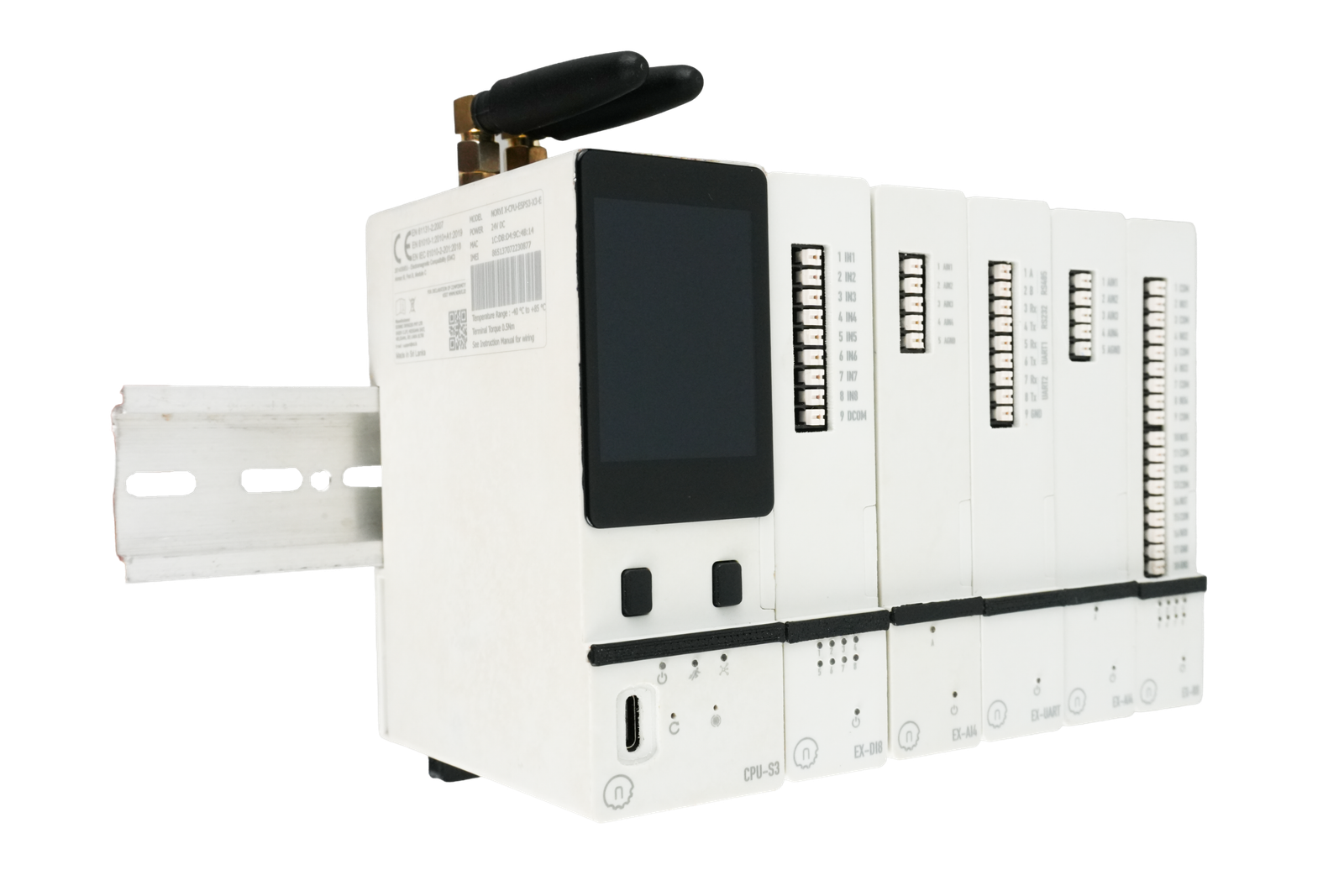
NORVI X is a modular ESP32 industrial IoT controller whose CPU options ship with the cellular modem built in. Every X CPU has Ethernet, RS-485, Wi-Fi, and Bluetooth as standard, plus two antennas on the cellular models. That makes X the lineup's answer to cellular plus everything else. Use it Ethernet-first with cellular backup, as a standalone gateway, or as the CPU for a 200-point expansion stack.
The base NORVI X1 CPU ($79) carries Wi-Fi, Ethernet, and Bluetooth only, with no cellular modem. Choose X2 or X3 for a cellular build. NORVI X is one of seven series in the NORVI ESP32 PLC lineup. See the full ESP32 PLC comparison for how it stacks up against fixed-I/O series.
 Battery-Powered Data Logger
EC-M12
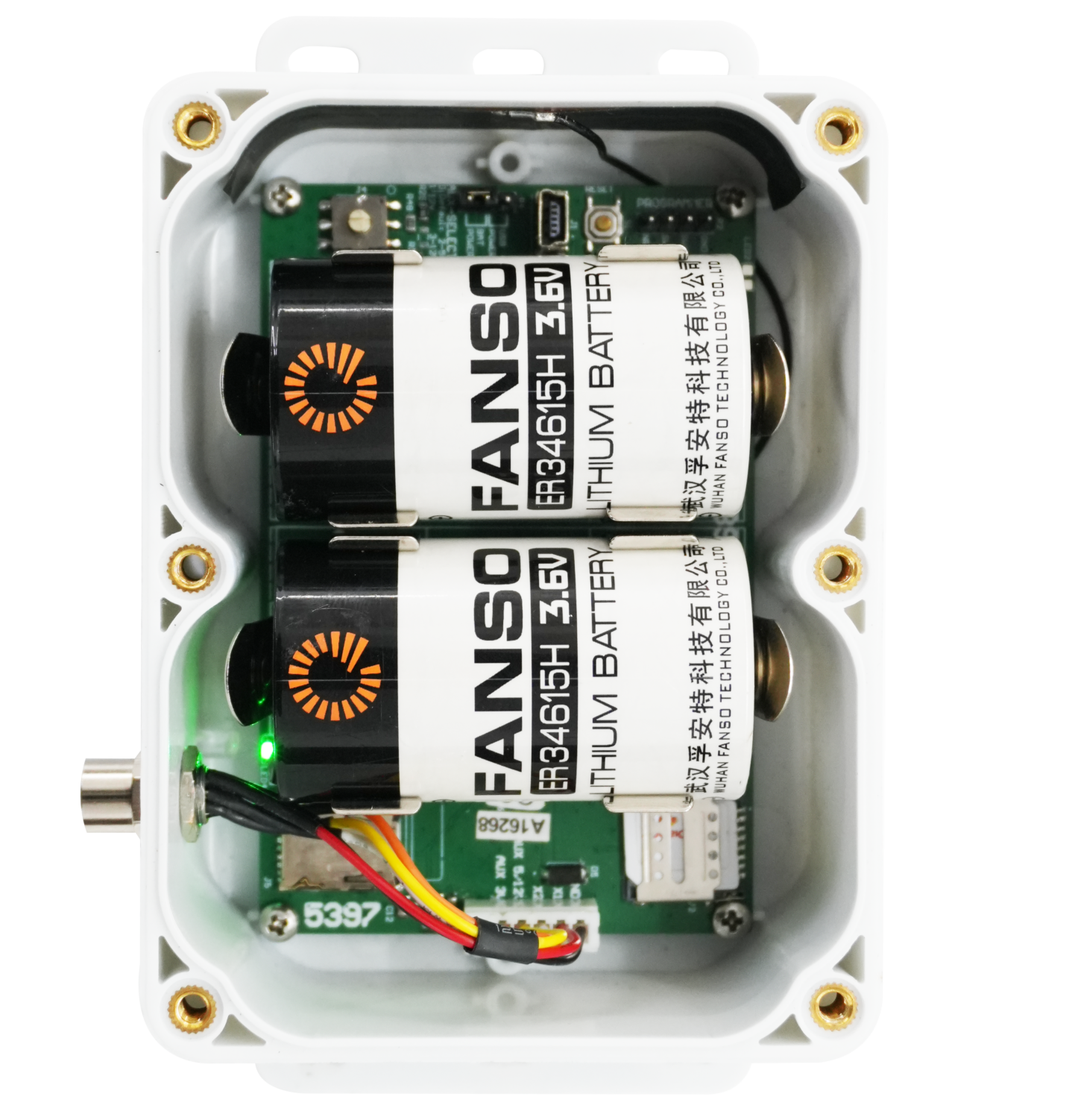
The EC-M12 is the battery-powered branch of the lineup, built for sites where grid power isn't an option. It uses an ultra-low-power STM32L072 microcontroller that sleeps, wakes, reads, transmits, and sleeps again. A dual-cell 38,000mAh Li/SOCl2 battery pack keeps it running for years in unattended field deployments.
Five I/O configurations (Model A to E): dual 4-20mA analog, RS-485/Modbus, dual digital, mixed digital + analog, and strain gauge. See the EC-M12 documentation hub for model-specific datasheets.
 Compact IoT Node / Gateway
Agent One
Agent One is a simple, low-I/O data-collection device that connects to a Modbus network or existing sensors. It wires in parallel, with nothing to rewire, and pushes the data straight to the cloud. It's the easiest way to add cellular telemetry to equipment that already exists. There's no PLC to replace.
Model families span LTE, NB-IoT, and LoRa variants. See the Agent One documentation hub for the full datasheet tree.
Modem Comparison
Which cellular module ships in which NORVI device? And what is each one best suited for?
| Quectel EC25 | SIMCom A7672 | SIMCom SIM7600 | SIMCom SIM7070 | |
|---|---|---|---|---|
| Class | High-speed 4G LTE | 2G / 4G, IoT-grade | 4G LTE | Cat-NB1 / Cat-M1 + 2G fallback |
| Found in | NORVI X3 · NORVI GSM (4G/LTE variants) | NORVI X2 | Agent One (LTE variants) | EC-M12 |
| Strength | Full-rate 4G for higher-bandwidth applications | Cost-efficient for telemetry-class data | Proven, widely deployed LTE path | Lowest power draw, built for battery nodes |
| Watch out | Highest-cost modem option | Lower data rate, fine for telemetry, not media rate TBD | No known caveats | NB-IoT roaming is patchy, see SIM & carrier guidance below |
| Guides | NORVI X documentation hub · GSM + ThingsBoard/Modbus guide | NORVI X documentation hub | Agent One documentation hub | EC-M12 guides (RS-485 to MQTT, sleep mode, Azure X.509) |
NORVI GSM also remains available with the SIMCom SIM800 (2G) module. It's a legacy option for regions where 2G is still the coverage floor, as 2G networks sunset globally.
Choosing the Radio: 4G LTE vs LTE-M vs NB-IoT vs Wi-Fi
Each technology trades off speed, coverage, and power differently. Match it to the deployment, not the other way around.
4G LTE (Cat 1 / Cat 4)
Higher data rates and lower lag. Best for real-time control, heavy MQTT traffic, and apps that can't handle slow uplinks.
LTE-M (Cat-M1)
Balances speed, coverage, and power use. It supports moving devices too. A middle ground for sensors that need more room than NB-IoT gives.
NB-IoT (Cat-NB1)
Covers the most ground and uses the least power. Best for fixed, low-data devices like the battery-powered EC-M12.
Wi-Fi (no cellular)
No recurring SIM cost, if the site already has reliable Wi-Fi or Ethernet. See NORVI ENET below for a non-cellular option.
Antenna, SIM & Carrier Guidance
Antenna Guidance
- NORVI GSM and NORVI X (all DIN-rail cellular devices) ship with external antennas: SMA connector for cellular, RP-SMA for Wi-Fi/Bluetooth. NORVI X carries two separate antenna connections.
- EC-M12 uses an internal cellular antenna. This is a deliberate design choice to preserve the sealed, IP67 environmental rating of the enclosure, so there's no external antenna to break, seal, or steal.
SIM Cards, eSIM & Carriers
- All cellular NORVI products take a nano SIM.
- eSIM support is available on the NORVI X and EC-M12 series.
- Global IoT SIMs used successfully with these devices in the field: 1NCE and Things Mobile.
- NB-IoT roaming is genuinely patchy. That's a network reality, not a device limitation, which is exactly why 2G fallback (EC-M12) and 4G fallback (other devices) matter: they keep a remote-OTA or debug path alive even where NB-IoT roaming fails, so you can still reach and update a device in the field.
Antenna Best Practice
- Mount external antennas outside metal panels, since a steel cabinet behaves like a Faraday cage.
- Keep the cellular antenna away from VFDs and contactors to reduce EMI.
- Use the supplied antenna, or match connector type and impedance if substituting.
- Check RSSI/RSRP signal strength during commissioning, not after handover.
When NOT to Choose a Cellular NORVI
Cellular isn't the right fit for every project. Here's when to look elsewhere in the NORVI range.
The system must run fully offline, with no future need for monitoring, remote support, or upgrades. A non-cellular controller works fine here, and costs less.
There's no one on the team to handle embedded programming. AI tools make this easier than before, but it still takes someone comfortable with firmware.
Recurring SIM costs don't fit the budget, and the site already has reliable Ethernet or Wi-Fi. NORVI ENET or a Wi-Fi device fits better here.
Datasheets & Application Guides
Start with the documentation hub for your device, or jump into a specific guide below. Every spec on this page is cross-checked against NORVI's own live product datasheets, not written from memory.
NORVI X Docs
Browse all NORVI X docsEC-M12 Docs
- RS-485 Modbus data over MQTT
- Sleep-mode low-power guide
- 4–20mA low-power application
- Secure Azure IoT Hub via X.509
Agent One & Case Studies
Browse all case studiesCommonQuestions
Can't find what you're looking for? Our team is available for a free technical consultation.
Get a Free Cellular Deployment Consultation
Tell NORVI's engineering team about your site, coverage, and power needs. We'll help you pick the right ESP32 industrial IoT controller and modem before you order.