
Off-grid asset monitoring solves a problem grid-connected sensors cannot touch. Telecom towers, pipeline valves, and rural pump stations often sit hours from the nearest power line. Technicians cannot run mains cable to every site. Diesel generators also cost too much to maintain remotely. Because of this gap, operators lose visibility exactly where it matters most.
This article builds on our earlier borehole monitoring guide. It extends the same off-grid asset monitoring approach to telecom towers and pipeline corridors. It also covers rural infrastructure that sits far from any grid connection. NORVI’s EC-M12 battery-powered data logger makes off-grid asset monitoring practical at scale. With off-grid asset monitoring in place, teams deploy sensors anywhere and still see live data.
Why Off-Grid Asset Monitoring Matters in Remote Infrastructure
Remote sites tend to fail quietly. A tower battery drains, a valve sticks, or a rural tank runs dry. Nobody notices until service actually stops.
Off-grid asset monitoring removes that guesswork entirely. Industry data shows the stakes clearly. Telecom specialists note that tower assets often carry high replacement values per site. As a result, unplanned downtime becomes expensive fast, according to Eutelsat research. Meanwhile, tower operators report that fuel theft and manual inspections drive up costs, per Compere Power. Instead of a fixed schedule, teams wait for real alerts to act.
Under off-grid asset monitoring, alerts fire only when a reading crosses a threshold. So maintenance becomes targeted, and travel costs fall sharply. Pipeline operators and rural utilities face the same math. Assets scattered across hundreds of kilometers cannot justify weekly visits. Because of this, battery-powered sensing becomes the only practical option.
Telecom Tower Monitoring Without Grid Power
Cell towers in remote corridors often run on batteries, solar, or diesel gensets. Grid power rarely reaches these sites at all. Operators still need to track battery voltage, shelter temperature, and fuel level. They need this data without sending a crew up a tower ladder. Off-grid asset monitoring handles this task directly and continuously. For tower operators, off-grid asset monitoring replaces guesswork with real numbers.
An EC-M12 unit wired to a 4-20 mA transmitter logs shelter temperature on a set schedule. It can also track DC bus voltage or fuel tank level the same way. Because the device supports NB-IoT, LTE-M, and 2G, it connects almost anywhere. Automatic network fallback means the unit finds a signal even in patchy corridors. No local gateway or LoRa network is required at all. Researchers note that battery status and cooling health are now essential for tower uptime, per ACL Digital.
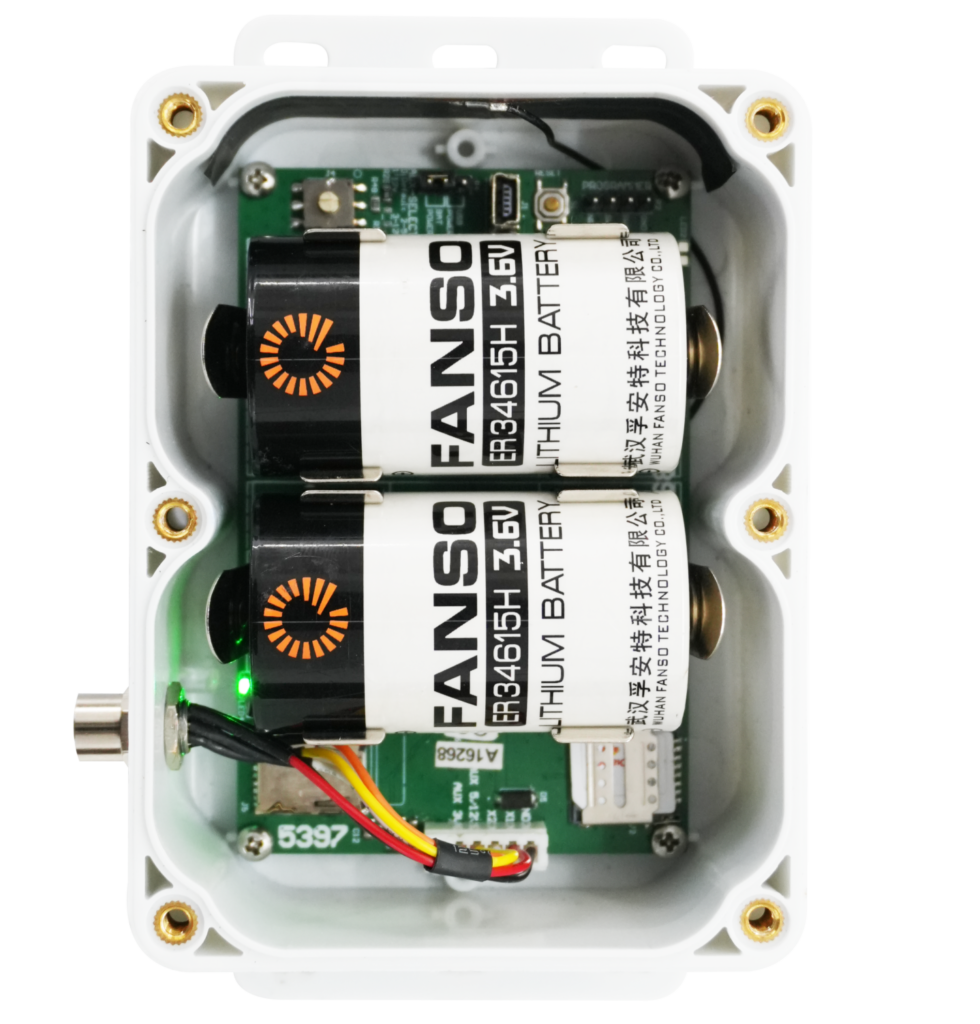
With EC-M12 at the shelter, operators get that visibility without new cable runs. The same logger also flags unusual fuel drops between scheduled refills. This pattern is a common theft indicator cited by tower monitoring vendors like DATOMS. Off-grid asset monitoring, in this context, protects both uptime and fuel budgets.
Pipeline and Right-of-Way Asset Monitoring
Pipeline networks stretch across terrain where new power runs are impossible. Sometimes trenching cable is simply too expensive to justify. Valve stations and pressure test points sit along routes crossing rivers and farmland. Off-grid asset monitoring lets operators place a sensor at each critical point. They no longer need to wait for a utility to extend grid service. Pipeline teams increasingly treat off-grid asset monitoring as a baseline requirement, not an upgrade.
For example, a pressure transmitter on an EC-M12 Model A reports line pressure hourly. Operators then catch a slow leak before it becomes a rupture. Similarly, Model D variants combine digital and analog inputs on one node. A single unit can monitor a relief valve state and flow rate together. The logger runs on dual 19,000 mAh lithium thionyl chloride cells.
Consequently, most pipeline deployments reach three to five years between battery changes. This assumes a fifteen-minute reporting interval, since pipeline teams rarely get a second chance after a missed anomaly. Instead of monthly walk-the-line inspections, crews prioritize only flagged segments. Off-grid asset monitoring turns a blind corridor into a data-rich one.
Rural Infrastructure: Water, Agriculture, and Utility Assets
Rural utilities face the same power gap, just at a larger scale. Water authorities manage reservoirs, boreholes, and irrigation networks across wide districts. Many of these districts have little or no grid access at all. As covered in our earlier borehole article, a pressure transmitter tracks groundwater level continuously. No power infrastructure is needed at the well head for this to work.
The same off-grid asset monitoring pattern extends to rural electrification and weather stations. Because reporting intervals are configurable, one hardware platform serves many site types. Boreholes, tanks, and pump stations all run on the same logger family. Furthermore, a single dashboard can display every site side by side.
Utility staff then manage a whole territory from one screen. This consistency matters for utilities without a dedicated IoT engineering team. Off-grid asset monitoring gives small teams enterprise-level visibility. Even a two-person utility crew can run off-grid asset monitoring across a whole district.
How the NORVI EC-M12 Enables Off-Grid Asset Monitoring
The EC-M12 was engineered around one goal. Deploy once, then monitor for years without a maintenance visit. Its IP67 enclosure withstands rain, dust, and extreme temperature swings. It operates reliably from minus 40 to plus 85 degrees Celsius. Two ER34615H lithium thionyl chloride cells supply a combined 38,000 mAh. The STM32L072 microcontroller sleeps between readings to conserve that power. The integrated cellular modem supports NB-IoT, LTE-M, and 2G together. Automatic fallback means a single SKU covers most global deployments.
Model A offers dual 4-20 mA inputs for pressure or level sensors. Model B adds RS-485 for Modbus-connected industrial equipment. Model C reads two digital inputs for switches or pulse meters. Model D blends digital and analog channels on one board. Model E supports strain-gauge sensors for load and weight measurement. Consequently, one product family covers towers, valve stations, and pump houses.
No custom hardware is needed for each new site type. Because data reaches the cloud directly over cellular, gateways become unnecessary. This is the core of dependable off-grid asset monitoring at scale.
Deployment Considerations for Off-Grid Sites
Planning an off-grid asset monitoring rollout starts with the reporting interval. Shorter intervals improve visibility but shorten battery life. Operators should match the interval to each asset’s real risk profile. A pipeline pressure point may need fifteen-minute readings. A rural tank level might only need hourly updates instead.
Confirm cellular coverage along the planned route, since even patchy 2G is often enough. Then choose the IO variant that matches the sensor at each site. Finally, decide on a dashboard strategy before hardware ships. That choice might be NORVI’s cloud platform or a private ThingsBoard instance.
It could also be an existing SCADA integration already in place. Because EC-M12 firmware connects to a customer’s own server, data stays under their control.
This flexibility is what makes off-grid asset monitoring adoptable at any scale.
Bringing Remote Assets into View
Grid power was never going to reach every tower, valve, and pump station. It never will, no matter how budgets expand. Off-grid asset monitoring closes that gap with hardware built for the job. Whether the asset sits on a ridge, a pipeline corridor, or a rural borehole, one logger fits. That same battery-powered unit delivers years of unattended data collection.
Teams that adopt off-grid asset monitoring replace scheduled visits with targeted maintenance. They catch failures before those failures become outages. To plan a deployment for telecom, pipeline, or rural assets, contact NORVI. Reach the team at support@icd.lk or orders@norvi.lk for pricing and technical details.