
Building industrial IoT products from scratch is genuinely hard. Most engineers underestimate what it takes. They get three months into a project and burn through a prototype budget. Modbus communication over a noisy factory floor still will not stabilize. This guide covers what custom IIoT development actually involves. It explains where projects fail and how to move from concept to a production-ready industrial device without wasting time.
If you want a second opinion after reading this, NORVI engineers offer a free 30-minute consultation. There are no strings attached.
What Custom IoT Development Actually Means in an Industrial Context
The term “custom IoT development” gets used loosely. For consumer electronics, the phrase might mean writing a mobile app that talks to an off-the-shelf sensor. In industrial settings, the scope is completely different.
An industrial project for Industry 4.0 typically means:
- Designing or selecting hardware that survives real industrial conditions, including voltage spikes, vibration, temperature swings, and EMI
- Integrating with legacy equipment using Modbus RTU, Modbus TCP, or OPC-UA
- Choosing the right connectivity layer, such as 4G LTE, NB-IoT, Ethernet, or Wi-Fi, based on the actual site environment
- Building firmware that handles data integrity, edge processing, and failsafe behavior
- Routing data reliably to cloud platforms or local SCADA systems
- Packaging everything in enclosures rated for the installation environment
Every layer of a custom IoT development project has decisions that cascade into the others. That is why doing this properly requires cross-disciplinary experience, not just embedded coding or cloud architecture in isolation.
The Five Stages of a Real Custom IoT Development Project
1. Requirements Definition
This is where most projects go wrong first. Vague requirements, such as “we need to monitor our machines remotely,” produce vague hardware specs. Before touching any hardware, define the following:
- Which signals are being captured, such as analog 4–20 mA, digital I/O, thermocouples, or encoders
- How frequently data needs to be sampled
- Latency tolerance for control decisions versus monitoring
- Whether the device needs to operate offline if connectivity drops
- Certification requirements, such as CE, FCC, or UL, if this is an OEM product
Requirements definition directly determines your BOM cost, firmware complexity, and time-to-market. Getting this wrong at stage one means rework at every stage after.
2. Hardware Platform Selection
For a custom IoT development project at industrial scale, you typically choose between three paths.
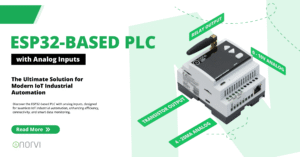
Off-the-shelf industrial controllers give you certified that proven hardware with industrial I/O already built in. Products like the NORVI X modular controller cut development time significantly, because the hard hardware problems are already solved.
Custom PCB design is justified when you need a specific form factor or very high volumes. It also fits when I/O configurations exist that no standard product covers. Expect four to six months for design, prototyping, and validation cycles.
Development board adaptations are risky in production. Using Raspberry Pi or Arduino in industrial settings is almost always a mistake. They work well for prototyping but lack the isolation, input protection, and thermal specs that factory environments demand.
The right answer depends on your volume, timeline, and how differentiated the hardware needs to be commercially.
3. Firmware and Protocol Development
This is the longest and most underestimated phase in custom IoT development projects. Stable industrial firmware requires:
- Deterministic task scheduling using FreeRTOS or a similar RTOS
- Robust Modbus, MQTT, or OPC-UA stacks, not quick implementations that fail under edge conditions
- OTA update mechanisms that cannot brick a device deployed remotely
- Watchdog routines and error recovery logic
- Calibration and configuration interfaces
Protocol compliance matters more than most developers expect. A Modbus implementation that works on a test bench will frequently fail against older PLCs with strict timing requirements. Testing against real target hardware early is not optional.
4. Cloud and Data Architecture
Where the data goes, and what structure it takes, determines how useful the system actually is. Key decisions at this stage include:
- Edge versus cloud processing: what gets computed locally before transmission
- Data broker selection, such as AWS IoT, Azure IoT Hub, ThingsBoard, or a self-hosted MQTT broker
- Time-series database selection for sensor data
- Dashboard and alerting layer design
Edge processing is not a nice-to-have for many of these projects. Bandwidth over NB-IoT is often limited. And a local control decision sometimes needs to happen faster than a cloud round-trip allows. In those cases, the edge logic becomes the product.
5. Certification, Production, and Deployment
Even after the design is proven, production introduces new challenges. PCB assembly yields, component availability, firmware flashing workflows, and end-of-line testing all need engineering attention. If you are selling a product commercially, CE or FCC certification also requires formal test house involvement. Design changes often follow that were not anticipated.
Where These Projects Typically Break Down
Based on real custom IoT development project experience, these are the failure patterns that appear most consistently.
Underestimating EMC requirements. A design that works in a lab will often fail on a motor-dense factory floor. Ground loops, cable shielding, and TVS protection on every external interface are not optional.
Treating connectivity as solved. 4G signal maps do not predict real-world performance inside metal enclosures. NB-IoT coverage also varies significantly by region. Plan for connectivity failure from day one.
Skipping the scalability conversation. A project that works for ten devices often falls apart at five hundred. Configuration management, OTA updates, and device provisioning need to be designed for scale, not retrofitted later.
Hardware-firmware mismatches. When hardware and firmware are developed in parallel without continuous integration testing, the integration phase becomes the real project.
Why Work with NORVI for Your IoT Project
NORVI is built by Iconic Devices, a hardware development company founded in Sri Lanka in 2014. The team brings over a decade of industrial automation and IoT product experience. Design, prototyping, and manufacturing all happen in-house, which means tighter iteration cycles and direct control over cost and quality.
NORVI’s product line covers the hardware layer that most of these projects need:
- NORVI X: modular ESP32-S3 controllers with isolated digital I/O, analog inputs, Modbus, and Ethernet; CE and RED certified
- NORVI GSM/4G: cellular-connected variants for remote asset monitoring
- NORVI X-SDC: custom OEM substation and expansion modules for bespoke I/O requirements
- Expansion modules: analog input and output, digital I/O, and relay output for scalable configurations
- EC-M12-BC: a pre-certified, battery-powered NB-IoT sensor node for remote monitoring without mains power
Beyond hardware, NORVI takes on full engagements from requirements definition through to certified production hardware.
Book a Free Industrial IoT Consultation
A 30-minute call with a NORVI engineer costs nothing for any custom IoT development project. This holds whether it is a concept, stuck in prototyping, or scaling up. It frequently surfaces issues or options that were not on the radar.
The consultation is technical, not a sales pitch. Come with your actual problem: I/O requirements, connectivity constraints, target environment, volumes, and timeline. You will leave with a clearer picture of the realistic path forward.
There is no obligation. If NORVI is not the right fit for your project, the engineers will tell you that directly.
Book your free industrial IoT consultation at norvi.io/free consultation.
NORVI Controllers: industrial IoT hardware and custom development, built by engineers, for engineers.

 by
by