ESP32-WROOM32 Core
Dual-core ESP32 platform with 4 MB flash on current model datasheets, giving developers access to the established ESP32 ecosystem.

The NORVI ESP32 cellular IoT controller is designed for remote industrial monitoring, control, telemetry and data acquisition over 2G GSM or 4G LTE.
Choose relay, transistor, 0-10V or 4-20mA I/O to match your field signals. The platform also includes RS-485, DIN-rail mounting and model-dependent microSD, RTC and Ethernet.
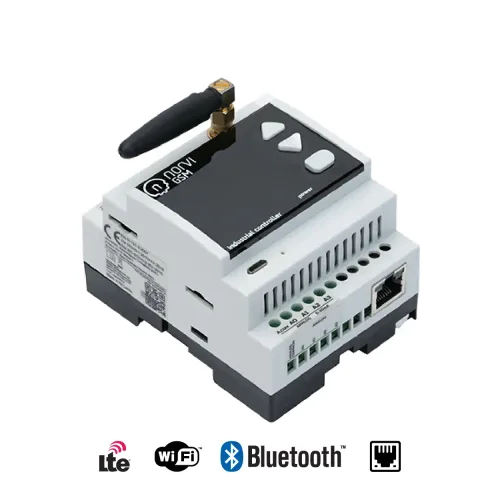
The NORVI GSM family combines local processing, industrial I/O and familiar ESP32 development tools for remote automation.
Dual-core ESP32 platform with 4 MB flash on current model datasheets, giving developers access to the established ESP32 ecosystem.
Choose SIM800-class GSM models or LTE models documented with Quectel EC25 and SIM7500 modem variants.
Sink/source digital inputs plus relay, transistor, 0-10V or 4-20mA I/O depending on the selected model.
Integrate Modbus RTU devices such as energy meters, sensors, drives and existing industrial equipment.
AE04 and AE08 variants add microSD and RTC features for local logging, timestamps and store-and-forward applications.
AE08 variants add W5500 Ethernet, useful for cellular-to-Ethernet gateways and sites that need multiple network paths.
A built-in 0.96-inch OLED and front-panel buttons support diagnostics, commissioning and local status display.
Program with Arduino IDE, ESP-IDF and compatible ESP32 libraries without proprietary PLC programming license fees.
Industrial enclosure, screw terminals and DIN-rail mounting make the family suitable for control panels and field cabinets.
Start with the family that matches your I/O density and local logging needs. Then choose the network and signal type.
Compact analog monitoring with digital inputs, two transistor outputs and RS-485.
Higher analog channel count with local storage and RTC for monitoring and data logging.
Relay or transistor-focused control for pumps, alarms, contactors and remote switching.
Most complete communication stack with storage, RTC and Ethernet plus multiple I/O choices.
Compare NORVI GSM with NORVI X, EC-M12 and Agent One by form factor, power source, cellular technology and application fit.
Compare the NORVI GSM range by network, I/O type and hardware family. Key I/O, price, model image and datasheet stay visible on every card.
A quick comparison before you enter model-specific wiring and modem details.
| Feature | AE02 | AE04 | AE07 | AE08 |
|---|---|---|---|---|
| Best fit | Compact analog monitoring | Higher-channel analog + logging | Remote discrete control | Full cellular gateway |
| 2G / 4G variants | Yes | Yes | Yes | Yes |
| 0-10V / 4-20mA | Yes | Yes | Not primary I/O | Yes |
| Relay / transistor | 2 transistor outputs | 2 transistor outputs | Relay or transistor | Relay or transistor variants |
| microSD + RTC | No | Yes | No | Yes |
| Ethernet | No | No | No | W5500 |
| RS-485 | Yes | Yes | Yes | Yes |
Use these platform specifications for initial selection. Exact I/O ratings, GPIO mapping and modem configuration remain model-specific.
* Confirm environmental, supply, electrical and cellular-band limits in the exact model datasheet used for the deployment.
The controller can acquire signals locally, execute automation logic and transfer selected data through cellular or local networks.
Designed for distributed or unattended installations where fixed internet is unavailable, unreliable or impractical.
Monitor level, pressure, flow and pump state, then send alarms or execute control actions without a fixed network connection.
Collect pulse, analog or RS-485 meter data and transmit selected readings to a central platform.
Track alarms, operating state and sensor values across dispersed power infrastructure using cellular backhaul.
Operate pumps and valves, monitor field sensors and schedule automation across remote agricultural sites.
Connect existing machinery, meters and sensors to a remote monitoring system through Modbus and cellular links.
Record environmental values locally on supported models and synchronize data when the communications path is available.
Use this page for product selection. Check wiring, I/O ratings, cellular bands, GPIO assignments and compliance details in the exact model documentation.
Select the network, open a controller family, then access the exact datasheet, user guide or test program. The section stays compact until a family is opened.
Share your sensor types, required outputs, cellular network and communication protocol. NORVI can help select the right cellular IoT controller for the application.
Can't find what you're looking for? Our team is available for a free technical consultation.
Current NORVI GSM datasheets list industrial safety and EMC references alongside model-specific electrical and environmental data.
Cellular modems, I/O counts, GPIO allocations and peripheral features vary by model. Use the selected model datasheet as the primary technical source.
Due to a surge in global demand, our production queue is at full capacity. We will not accelerate production at the expense of quality - every device undergoes full CE / EMC compliance, regardless of order volume.
| Order Quantity | Lead Time | Notes |
|---|---|---|
| Under 10 units | 2-3 wks | Standard processing |
| 10 - 100 units | 4-5 wks | Mid-volume batch |
| Above 100 units | 6+ wks | Contact us for slot |