Every industrial environment is different. Therefore, a one-size-fits-all controller simply does not work in the real world. That is exactly why NORVI designs and manufactures customized industrial IoT devices that match the precise requirements of your application – from input/output configuration to communication protocol and enclosure type.
Whether you are building an automated production line, a remote monitoring system, or a connected field device, NORVI engineers deliver a solution tailored to your needs.
What Are Customized Industrial IoT Devices?
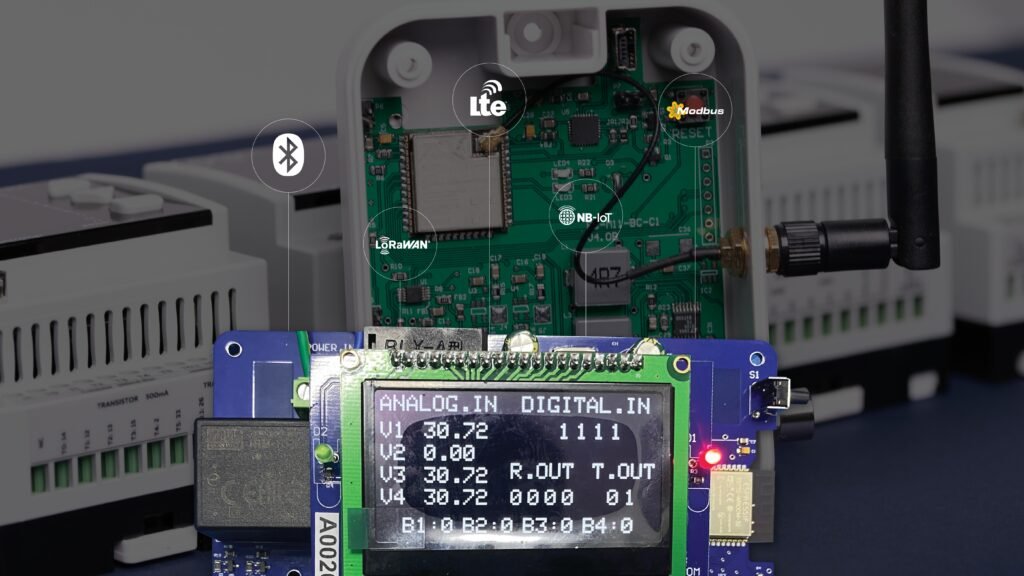
A customized industrial IoT device is a purpose-built controller that engineers configure – or fully redesign – to match a specific set of application requirements. Rather than forcing a standard product to fit your system, you receive a device that fits perfectly from day one.
NORVI builds these devices on proven platforms such as the ESP32 SoC and STM32 microcontrollers, so you benefit from field-tested reliability without compromising on flexibility. Furthermore, because NORVI’s team handles embedded system design in-house, the customization process is faster and more cost-effective than working with a third-party hardware vendor.
Why Choose a Custom ESP32 Controller for Your Application?
Standard off-the-shelf controllers often force engineers to work around limitations. In contrast, a custom ESP32 controller gives you:
- Exact I/O configuration – choose digital inputs, relay outputs, analog 0–10V, or 4–20mA combinations that match your sensors and actuators
- The right communication standard – select Wi-Fi, Ethernet, LoRa, NB-IoT, GSM-LTE, or Zigbee depending on your network environment
- Suitable enclosure and mounting – DIN rail, panel mount, IP67-rated outdoor housing, or a custom form factor
- Compatible programming environment – Arduino IDE, OPC Server, RapidSCADA, or Soapbox Snap
As a result, you spend less time on workarounds and more time deploying productive solutions.
How NORVI Builds Your Custom IoT Device
Step 1 – Requirements Analysis
First, NORVI’s engineers sit down with you to understand the full application scope. This includes the number and type of inputs and outputs, the communication infrastructure on site, the operating environment (temperature range, vibration, moisture), and the programming tools your team prefers.
Step 2 – Platform Selection and Design
Next, the team selects the best base platform for your requirements. For applications that need Wi-Fi or Bluetooth connectivity and strong processing power, the ESP32-WROOM32 is the default choice. For ultra-low-power deployments where battery life must stretch over months or years, NORVI selects the STM32L series microcontroller instead.
After that, engineers alter the I/O types, communication interfaces, and any expansion module requirements. For example, if your application requires thermocouple temperature inputs alongside LoRa connectivity, NORVI integrates both into a single, compact device.
Step 3 – Prototyping and Validation
Once the design is finalised, NORVI builds a working prototype and puts it through validation testing. This step ensures the device performs reliably under the actual conditions it will face in the field. Consequently, you receive a controller that is ready to deploy with minimal additional testing on your side.
Step 4 – Production and Delivery
Finally, NORVI moves the validated design into production. Since the company has completed hundreds of successful customisation projects, the production process is well-established and efficient.
Key Customization Options for Industrial IoT Solutions
Input and Output Configuration
NORVI can configure your device with any combination of the following I/O types:
- Optically isolated digital inputs (24V tolerant) for reliable signal reading in noisy industrial environments
- Relay outputs (up to 5A, 30VDC / 250VAC) for switching loads directly
- Transistor outputs for low-voltage, high-speed switching
- 16-bit analog inputs supporting 0–10V DC and 4–20mA industrial signal ranges
- Analog outputs with 12-bit resolution over I2C
Because NORVI uses the MCP23008 and MCP23017 I2C I/O expanders, scaling the number of I/O channels is straightforward. Therefore, you can expand a device without redesigning the entire controller.
Communication and Connectivity
Depending on your site infrastructure, NORVI configures your custom IoT device with the right wireless or wired communication standard:
- Wi-Fi (802.11 b/g/n) for LAN-connected industrial environments
- Ethernet via the NORVI ENET series for wired, deterministic communication
- LoRa for long-range, low-power wireless sensor networks
- NB-IoT and GSM-LTE for cellular-connected remote applications
- Zigbee for short-range mesh network topologies
Moreover, all NORVI IoT controllers support the MQTT protocol, which is the leading lightweight messaging standard for Industrial IoT. MQTT eliminates the polling overhead of HTTP and delivers real-time, bidirectional communication between field devices and cloud platforms.
Power Supply Options
NORVI designs custom controllers for three primary power scenarios:
- Grid-powered applications – standard 12–24V DC supply with Wi-Fi connectivity and IP67 enclosure options
- Solar-powered applications – optimised for intermittent power availability with LoRa, Zigbee, or NB-IoT
- Battery-powered applications – STM32L ultra-low-power microcontrollers that deliver years of battery life, along with the ability to shut off external sensors during sleep cycles
Industries That Benefit from Custom Industrial IoT Devices
NORVI’s customized industrial IoT devices are in active use across a wide range of sectors. Specifically, these include:
- Manufacturing and factory automation — machine monitoring, relay control, conveyor management
- Agriculture — remote soil and weather monitoring, irrigation control over LoRa or NB-IoT
- Construction equipment — rugged controllers for harsh outdoor environments
- Energy and utilities — grid monitoring, solar power management, meter reading
- Building management — HVAC monitoring, access control, environmental sensing
In every case, the ability to specify the exact I/O and communication configuration reduces installation complexity and eliminates unnecessary cost.
Frequently Asked Questions About Custom IoT Device Development
NORVI works with both prototype-scale and production-scale orders. Contact the NORVI team directly to discuss your specific volume requirements and lead times.
Yes. All NORVI ESP32-based custom controllers are compatible with the Arduino IDE. Additionally, you can use OPC Server, RapidSCADA, and Soapbox Snap depending on your preferred development environment.
Development time depends on the level of customisation required. Simple I/O and communication changes on an existing platform typically take a shorter time than a fully new hardware design. NORVI’s engineers will give you a realistic timeline during the initial requirements discussion.
NORVI custom devices support Wi-Fi, Ethernet, LoRa, NB-IoT, GSM-LTE, Zigbee, and MQTT. Furthermore, the controllers are compatible with I2C and UART-based expansion modules.
Yes. NORVI designs its controllers to IEC industrial specifications and offers IP67-rated enclosures for outdoor and moisture-prone environments. Moreover, the optically isolated I/O protects the controller from electrical noise common in industrial settings.
Start Your Custom IoT Device Project With NORVI
If your application demands more than a standard controller can offer, NORVI’s engineering team is ready to help. Because NORVI combines years of embedded system expertise with a proven range of ESP32 and STM32 platforms, your custom IoT device development moves faster and more reliably than starting from scratch.
Contact NORVI today to discuss your requirements and take the first step toward a customized industrial IoT device that works exactly the way your application demands.