
Industrial automation is evolving rapidly, and engineers worldwide are searching for smarter, more cost-effective alternatives to traditional Programmable Logic Controllers (PLCs). NORVI controllers offer a powerful solution – combining the ruggedness of industrial hardware with the flexibility of microcontroller-based programming, including full support for ladder logic. In this guide, you will discover exactly how ladder logic programming works in NORVI controllers, why it matters for modern industrial applications, and how you can implement it in your own projects.
What Is a PLC and Why Does It Matter in Industry?
A Programmable Logic Controller (PLC) is a specialized industrial computer that manufacturers design specifically for control systems in harsh environments. Unlike general-purpose computers, PLCs handle high reliability demands, extreme temperatures, vibration, and electrical noise – conditions that would cause ordinary hardware to fail.
Originally, engineers developed PLCs to replace electromechanical relays. Rather than wiring dozens of physical relays together, a PLC runs a stored program that simulates relay connectivity through software logic. As a result, manufacturers gained the ability to change production logic without rewiring an entire panel. Today, PLCs power everything from simple conveyor belts to complex robotic assembly lines.
Furthermore, PLCs follow international standards, particularly IEC 61131-3, which defines five programming languages – including ladder logic. This standardization ensures that engineers across different industries and countries can read, write, and maintain PLC programs consistently.
What Is Ladder Logic Programming?
Ladder logic is the most widely used PLC programming language in the industrial world. Engineers and technicians use it because it closely resembles traditional electrical relay diagrams — making it easy to learn and interpret, even for those without deep software development backgrounds.
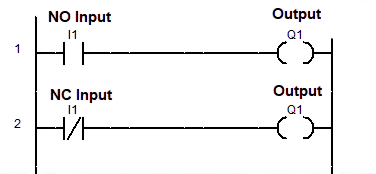
Visually, a ladder logic program looks like a ladder. Each horizontal rung represents a logical condition or control action. On the left rail, inputs such as switches, sensors, and timers appear as contacts. On the right rail, outputs such as motors, valves, and alarms appear as coils. When the program scans a rung from left to right and finds all contacts in the ON state, it energises the output coil.
Because of its visual nature, ladder logic allows maintenance technicians to trace faults quickly and update logic without writing a single line of traditional code. Consequently, it remains the dominant choice for industrial automation professionals worldwide, even as newer programming languages gain popularity.
Core Elements of Ladder Logic
- Normally Open (NO) Contact: Passes current when the associated input is active (ON).
- Normally Closed (NC) Contact: Passes current when the associated input is inactive (OFF).
- Output Coil: Activates an output device when rung conditions are met.
- Timers and Counters: Introduce time delays and count-based logic into programs.
- Function Blocks: Perform mathematical operations, data comparisons, and more advanced control tasks.
Why Engineers Are Replacing PLCs with Microcontrollers
In recent years, the rise of affordable, powerful microcontrollers has disrupted industrial automation. Platforms such as the ESP32 demonstrate that microcontrollers can handle complex control tasks at a fraction of the cost of traditional PLCs. Therefore, engineers and system integrators increasingly ask: why pay thousands of dollars for a PLC when a microcontroller can do the same job?
However, two critical challenges have historically held microcontrollers back from widespread industrial adoption:
- Environmental Durability: Standard development boards lack the ruggedness needed for industrial environments. Vibration, temperature extremes, humidity, and electrical noise quickly damage consumer-grade hardware.
- IEC Signal Compatibility: Industrial sensors and actuators follow IEC standards, typically operating at 24V DC levels. Most microcontrollers natively support only 3.3V or 5V logic, requiring additional interface hardware.
Despite these limitations, the demand for low-cost, IoT-connected industrial controllers continues to grow. As a result, innovative manufacturers have developed industrial-grade microcontroller platforms that address both issues directly.
NORVI Controllers: The Industrial Microcontroller Solution
NORVI industrial controllers bridge the gap between traditional PLCs and modern microcontrollers. Iconic Devices, the Sri Lanka-based manufacturer behind NORVI, designs these devices specifically for industrial environments – solving both key challenges that previously limited microcontroller adoption in manufacturing.
Industrial-Grade Ruggedness
Unlike standard development boards, NORVI controllers use robust enclosures and components that withstand harsh industrial conditions. They handle wide temperature ranges, electrical noise (EMI), and vibration – making them suitable for factory floors, control panels, and outdoor installations. Additionally, their DIN rail mounting design integrates seamlessly into existing industrial panel setups.
IEC-Compliant I/O Interfaces
NORVI controllers natively support industrial-standard I/O signals. Depending on the model, they offer digital inputs and outputs at 24V DC levels, analog inputs for 0-10V and 4-20mA signals, and dedicated measurement channels for temperature, pressure, and flow rate. Therefore, engineers connect NORVI controllers directly to standard industrial sensors and actuators without requiring additional signal conditioning hardware.
ESP32-Based Intelligence with IoT Connectivity
At the core of every NORVI controller sits an ESP32 microcontroller – one of the most capable and widely supported embedded processors available today. The ESP32 provides built-in Wi-Fi and Bluetooth, ample processing power for control logic, and a massive ecosystem of libraries and community support. Moreover, this connectivity enables NORVI controllers to participate in IIoT (Industrial Internet of Things) architectures, pushing data to cloud platforms and SCADA systems in real time.
NORVI Controller Product Lineup
The NORVI range covers a wide variety of industrial use cases. Key models include:
- NORVI IIOT: Industrial ESP32 platform for IIoT applications with digital and analog I/O.
- NORVI ENET: Ethernet-connected industrial ESP32 for wired network integration.
- NORVI GSM: ESP32-based controller with GSM/GPRS for remote and cellular-connected applications.
- NORVI Arita / Cema: Arduino-compatible industrial controllers for broader programming flexibility.
How Ladder Logic Programming Works in NORVI Controllers
Since NORVI controllers run on the ESP32 microcontroller rather than a traditional PLC processor, ladder logic programming requires a bridge – and that bridge comes from an innovative open-source project.
Developer Leonardo Fernandes created the IoT Ladder Editor, a desktop Java application that generates Arduino-compatible C++ code from ladder logic diagrams. In other words, you design your control program visually using ladder rungs and symbols – exactly as you would on a traditional PLC – and the editor automatically converts that diagram into code that runs natively on the ESP32.
IoT Ladder Editor: Key Features
- Visual Ladder Logic Design: Build programs using familiar contacts, coils, timers, and counters in a graphical interface.
- Automatic Code Generation: The tool converts your ladder diagram directly into Arduino-compatible source code.
- ESP32 Compatibility: Generated code compiles and uploads via the Arduino IDE – no proprietary software or expensive licences required.
- Open-Source and Free: The project is freely available on GitHub, making it accessible to engineers and students worldwide.
Step-by-Step Programming Workflow
Programming a NORVI controller with ladder logic follows a straightforward process. First, you download and install the IoT Ladder Editor on your computer. Next, you open the editor and create a new project, selecting your target hardware. Then, you design your ladder logic program by adding rungs, placing contacts to represent inputs, and adding coils to represent outputs. After completing the design, you click the code generation button – the editor produces complete Arduino source code. Finally, you open this code in the Arduino IDE, select the correct board and port, and upload it directly to your NORVI controller.
As a result, the entire process feels familiar to PLC programmers while remaining accessible to anyone comfortable with the Arduino ecosystem. Moreover, because the underlying code is standard Arduino C++, advanced users can extend the generated code with custom functions, MQTT communication, cloud integration, and more.
Advantages of Using Ladder Logic on NORVI Controllers
Choosing NORVI controllers for ladder logic programming delivers several compelling advantages over traditional PLC systems. Furthermore, these benefits make NORVI an attractive option for both new automation projects and upgrades to existing systems.
- Significantly Lower Cost: NORVI controllers cost a fraction of equivalent traditional PLCs. Therefore, small manufacturers and system integrators can implement professional automation without large capital investment.
- No Proprietary Software Licences: Traditional PLCs require expensive proprietary programming software. In contrast, NORVI uses the free Arduino IDE and open-source IoT Ladder Editor.
- Built-In IoT Connectivity: Unlike most traditional PLCs, NORVI controllers include native Wi-Fi, Bluetooth, and optional GSM/Ethernet – enabling seamless integration with cloud platforms and remote monitoring dashboards.
- Familiar Programming Model: PLC engineers and technicians can immediately apply their ladder logic knowledge without learning an entirely new paradigm.
- Extendable and Flexible: Because the controller runs on Arduino/ESP32, developers can add custom code, integrate third-party libraries, and implement advanced features beyond standard ladder logic.
- Industrial Reliability: NORVI’s rugged design and IEC-compliant I/O ensure the controller performs reliably in real industrial environments – not just the laboratory.
Practical Applications of Ladder Logic in NORVI Controllers
Engineers across a wide range of industries deploy NORVI controllers with ladder logic programming to automate their processes. The following examples illustrate the versatility of this approach:
- Water Treatment Plants: NORVI controllers manage pump sequencing, valve control, and flow monitoring using ladder logic rungs that mirror traditional PLC programs.
- Agricultural Automation: Irrigation systems use ladder logic to control pump activation based on soil moisture sensor inputs and time-based schedules.
- Building Management Systems: HVAC, lighting, and access control systems benefit from ladder logic’s simple conditional logic model.
- Manufacturing Lines: Conveyor control, product counting, and machine interlocking all translate naturally into ladder logic rungs on NORVI hardware.
- Energy Monitoring: Combined with analog I/O, NORVI controllers measure voltage, current, and power factor, triggering alarms and control actions through ladder logic conditions.
Getting Started: Resources and Next Steps
If you want to begin implementing ladder logic on a NORVI controller, several resources are available to guide you through the process. To begin with, the NORVI team has published a comprehensive step-by-step application note on Instructables, walking through the complete setup and programming workflow. Additionally, the open-source IoT Ladder Editor project by Leonardo Fernandes is freely available on GitHub, where you can download the software, explore example projects, and contribute to development.
Furthermore, the NORVI documentation portal at norvi.lk/docs provides hardware pinout diagrams, wiring guides, and programming tutorials for each controller model. Whether you are an experienced PLC programmer exploring cost-effective alternatives or an engineer new to industrial automation, these resources provide everything you need to get your first NORVI ladder logic program running.
In addition to documentation, the NORVI product store at shop.norvi.lk offers the full lineup of industrial controllers, expansion modules, and accessories – allowing you to select the exact hardware that matches your application requirements.
Conclusion: The Future of Industrial Automation Starts Here
Ladder logic programming in NORVI controllers represents a genuine step forward for industrial automation. By combining the familiarity and reliability of ladder logic with the cost efficiency, connectivity, and flexibility of ESP32-based hardware, NORVI delivers a compelling alternative to traditional PLCs.
As a result, engineers who previously needed large budgets and proprietary ecosystems can now build robust, IEC-compatible automation systems at a fraction of the cost. Moreover, the open-source IoT Ladder Editor makes the programming process accessible without sacrificing the visual clarity that makes ladder logic the industry’s preferred language.
Whether you are automating a small production line, building a remote monitoring system, or replacing an ageing PLC, NORVI controllers with ladder logic programming provide the performance, reliability, and connectivity that modern industrial applications demand. Therefore, now is the ideal time to explore what NORVI can do for your automation projects.
Ready to Get Started?
Explore the full NORVI controller range at norvi.lk/products or visit the NORVI store at shop.norvi.lk. For full setup instructions, read the Ladder Logic for ESP32 guide on Instructables, and download the free IoT Ladder Editor on GitHub.

 by
by