
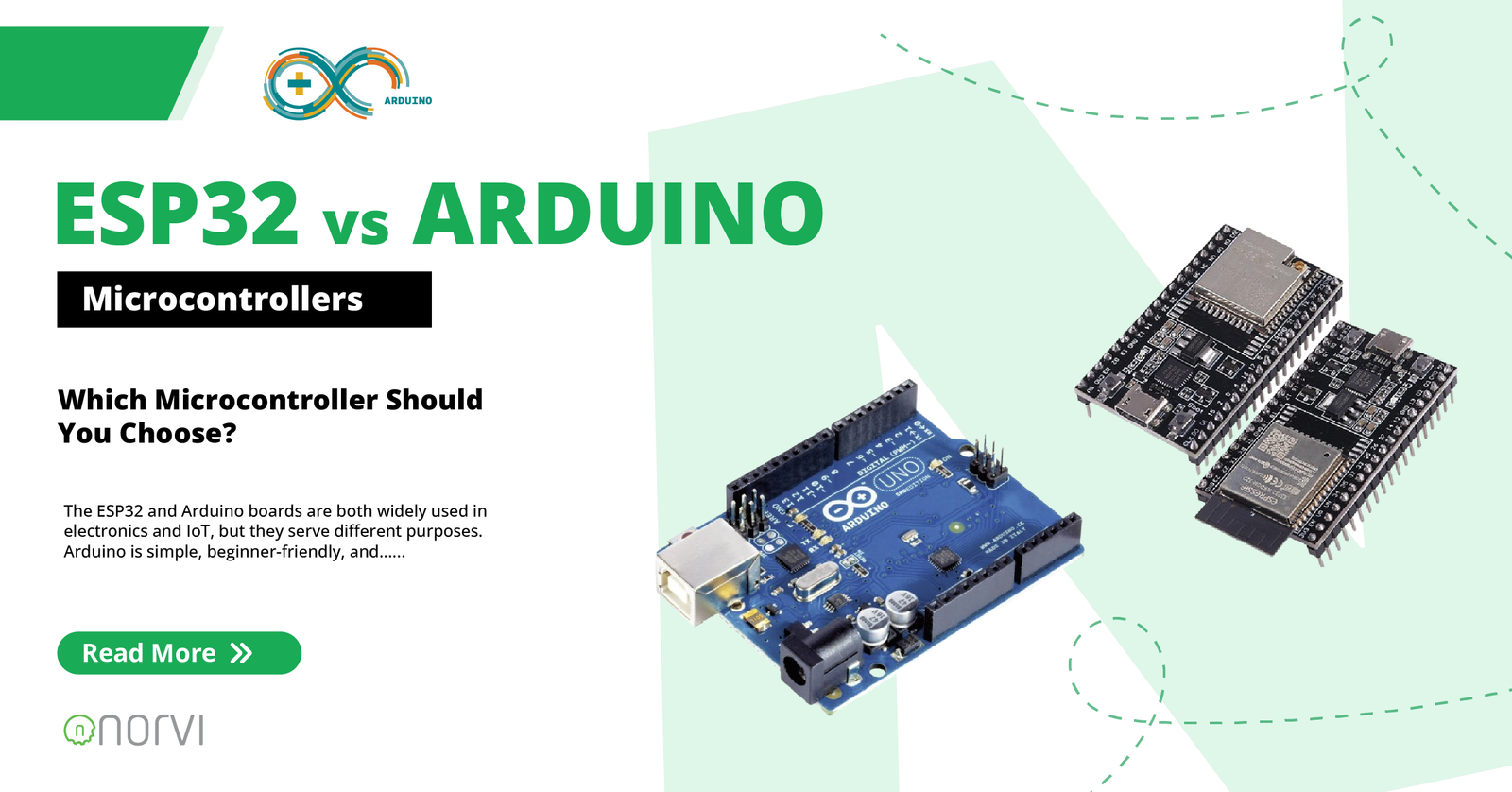
The ESP32 and Arduino boards are both widely used in electronics and IoT, but they serve different purposes. Arduino is simple, beginner-friendly, and perfect for basic projects, while the ESP32 offers faster processing, built-in Wi-Fi/Bluetooth, and low power consumption – making it ideal for advanced IoT, automation, and industrial applications.
When diving into the world of embedded systems and IoT development, two boards dominate the conversation – Arduino and ESP32. While both are incredibly popular, they’re built for different purposes. Understanding their strengths, limitations, and ideal use cases can help you choose the right one for your project.
Arduino Overview – The Beginner-Friendly Choice
The Arduino Uno, based on the ATmega328P microcontroller, is the gold standard for learning electronics. Its biggest strengths are simplicity, large community support, and an easy-to-use programming environment.
Key Specifications of Arduino Uno:
- Processor: 8-bit ATmega328P
- Clock Speed: 16 MHz
- Operating Voltage: 5V
- RAM: 2 KB
- Flash Memory: 32 KB
- Connectivity: Requires add-on shields for Wi-Fi/Bluetooth
- I/O: 14 digital pins, 6 analog inputs

Best For:
- Education and prototyping
- Basic automation projects
- Beginners exploring electronics without complexity
ESP32 Overview – The IoT Powerhouse
The ESP32, developed by Espressif Systems, is a high-performance, low-power microcontroller designed for IoT, wireless communication, and advanced embedded systems. Unlike the Arduino Uno, it has built-in Wi-Fi and Bluetooth, allowing direct connectivity without additional modules.
Key Specifications of ESP32:
- Processor: Dual-core 32-bit Xtensa LX6
- Clock Speed: Up to 240 MHz
- Operating Voltage: 3.3V
- RAM: ~520 KB SRAM
- Flash Memory: 4 MB or more
- Connectivity: Wi-Fi 802.11 b/g/n, Bluetooth 4.2 & BLE
- Extra Features: Touch sensors, multiple ADC/DAC channels, ultra-low power sleep modes

Best For:
- IoT projects with real-time data transfer
- Industrial automation and smart monitoring
- AI-enabled edge computing tasks
- Battery-powered and solar-powered devices
ESP32 vs Arduino: Detailed Comparison Table
| Feature | Arduino Uno | ESP32 |
|---|---|---|
| Processor | 8-bit ATmega328P | Dual-core 32-bit Xtensa LX6 |
| Clock Speed | 16 MHz | Up to 240 MHz |
| Operating Voltage | 5V | 3.3V |
| RAM | 2 KB | ~520 KB SRAM |
| Flash Memory | 32 KB | 4 MB or more |
| Wi-Fi/Bluetooth | No | Yes (built-in) |
| Power Efficiency | Moderate | Excellent with deep sleep modes |
| I/O Pins | 14 Digital, 6 Analog | 30+ GPIO (varies by board) |
| Programming | Arduino IDE | Arduino IDE, PlatformIO, ESP-IDF |
| Price | Lower | Slightly higher |
| Best Use Cases | Education, small automation | IoT, AI, industrial control |
When to Use Arduino
Choose Arduino if:
- You’re learning microcontrollers for the first time.
- You want an easy platform with lots of tutorials and libraries.
- You’re working on simple projects without wireless communication needs.
- You need direct compatibility with 5V sensors and actuators.
When to Use ESP32
Choose ESP32 if:
- You need built-in Wi-Fi or Bluetooth for IoT communication.
- You require higher processing speed for real-time tasks.
- You want to build low-power devices that can run on batteries for months.
- You’re developing industrial-grade or automation projects with complex requirements.
Final Verdict – ESP32 vs Arduino for IoT and Automation
For beginners and education, the Arduino Uno is still unbeatable in terms of simplicity. However, when it comes to modern IoT applications, industrial monitoring, and automation, the ESP32 clearly stands out because of its speed, connectivity, and scalability.
Pro Tip for Professionals: If you need a rugged, industrial-ready ESP32 solution, explore NORVI ESP32 Industrial Controllers. They come with RS-485, Modbus support, expansion modules, and robust enclosures, making them ideal for factory automation, smart agriculture, and remote monitoring systems.

 by
by