

ESP32 HMI with LVGL Is Better Than Nextion
Human–Machine Interfaces (HMIs) play a critical role in modern automation, IoT systems, and industrial equipment. They provide a visual interface that allows operators to monitor data, control devices, and interact with embedded systems efficiently.
When developing an HMI for microcontrollers such as ESP32, two popular approaches are commonly considered:
- Using Nextion HMI displays
- Building the interface using LVGL on an ESP32 HMI
While Nextion displays are widely used for quick implementations, many developers and system designers are increasingly adopting ESP32 HMI solutions powered by LVGL because they offer far greater flexibility, performance, and customization.
This article explains why ESP32 HMI with LVGL is a better long-term solution than Nextion, especially for advanced embedded and industrial applications.
What Is LVGL?
LVGL (Light and Versatile Graphics Library) is an open-source embedded graphics library designed for creating modern graphical user interfaces on microcontrollers and embedded devices.
The library provides a comprehensive framework for designing user interfaces with widgets, animations, and touch interaction while maintaining a low memory footprint suitable for embedded hardware.
LVGL allows developers to build visually rich and responsive user interfaces directly on microcontrollers like ESP32 without requiring a separate display controller.
Key Characteristics of LVGL
- Lightweight and optimized for microcontrollers
- Open-source with strong community support
- Hardware-independent architecture
- Supports multiple display types and resolutions
- Works with platforms such as ESP32, STM32, and ARM Cortex-M devices
Because of this flexibility, LVGL has become one of the most widely adopted GUI frameworks for embedded devices.
What Is a Nextion Display?
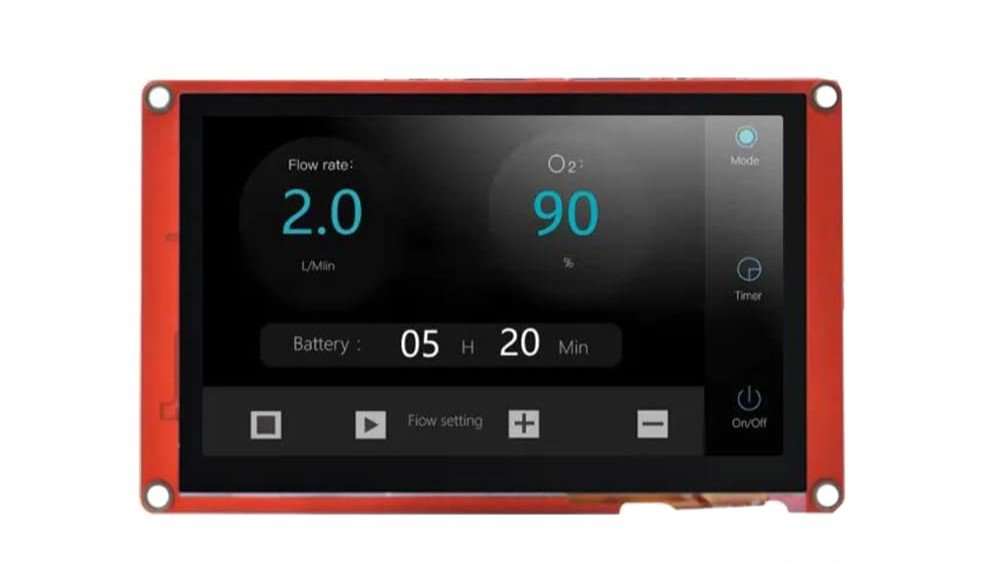
Nextion is a popular HMI solution that combines:
- A touchscreen display
- A built-in microcontroller
- A graphical interface editor
In a typical Nextion setup, the GUI is designed using the Nextion Editor software and uploaded to the display. The microcontroller communicates with the display using simple serial commands.
Limitations of Nextion Displays
- Limited graphics capability
- Restricted customization
- Proprietary ecosystem
- Reduced control over rendering and UI behavior
These limitations become more noticeable when building complex applications or industrial systems.
ESP32 HMI with LVGL: How It Works
In an ESP32 HMI architecture, the ESP32 itself runs the graphical interface using LVGL.
Instead of relying on an external display controller like Nextion, the ESP32 performs:
- UI rendering
- Logic processing
- Communication
- Device control
This unified architecture allows the developer to build powerful embedded interfaces without the limitations imposed by external display modules.
Modern ESP32 HMI devices integrate:
- ESP32 or ESP32-S3 processors
- Touchscreen displays
- Wi-Fi and Bluetooth connectivity
- Industrial communication interfaces such as RS-485
- Digital and analog I/O for automation systems
This combination transforms the HMI from a simple display into a complete embedded control system.
Why ESP32 HMI with LVGL Is Better Than Nextion
Full Customization of the User Interface
LVGL allows full customization of:
- Widget styles
- Colors and themes
- Fonts and layouts
- Animations
- User interactions
Nextion relies heavily on its proprietary editor, which restricts UI customization and design flexibility.
Advanced Graphics and Visual Effects
LVGL supports modern graphical features such as:
- Anti-aliasing
- Gradient backgrounds
- Shadows
- Transparency
- Smooth animations
Nextion displays typically rely on static image-based UI components, limiting visual quality and responsiveness.
Higher Performance and Responsiveness
When using LVGL with an ESP32, the interface is rendered directly by the microcontroller:
- Faster screen updates
- Real-time UI interactions
- Dynamic data visualization
LVGL also supports efficient memory management and optimized rendering pipelines for embedded devices.
Nextion displays communicate via serial commands, which can reduce UI responsiveness for complex screens.
Open-Source Ecosystem
LVGL is open-source, which allows developers to:
- Modify and extend functionality
- Integrate additional features
- Access community support
LVGL integrates with:
- SquareLine Studio
- PlatformIO
- Arduino IDE
- ESP-IDF
Nextion relies on a closed ecosystem and proprietary tools.
More Powerful Hardware Architecture
ESP32 HMI solutions often include:
- Dual-core ESP32 processors
- Wi-Fi and Bluetooth
- Ethernet communication
- Industrial I/O interfaces
- PLC-style control capabilities
This integration allows ESP32 HMIs to function as both displays and controllers, unlike standard Nextion modules.
Better for Industrial and IoT Applications
ESP32 HMIs powered by LVGL are ideal for:
- Industrial automation
- Smart building systems
- IoT monitoring dashboards
- Machine control panels
- Smart agriculture interfaces
- Energy monitoring systems
ESP32 supports Wi-Fi, Ethernet, and RS-485, enabling HMIs to communicate directly with sensors, PLCs, and cloud platforms.
Example Use Case: Home Automation Dashboard
A home automation system can monitor and control:
- Lighting
- HVAC systems
- Security sensors
- Energy consumption
Using LVGL on an ESP32 HMI, developers can create:
- Interactive dashboards
- Real-time sensor graphs
- Multi-screen navigation
- Animated UI elements
This results in a more modern, interactive interface compared to Nextion.
When Nextion May Still Be Useful
Nextion is suitable for:
- Very simple projects
- Rapid prototypes
- Applications with minimal UI requirements
It reduces development complexity but is limited for advanced applications.
Final Comparison: ESP32 HMI with LVGL vs Nextion
| Feature | ESP32 HMI with LVGL | Nextion Display |
|---|---|---|
| UI Customization | Very High | Limited |
| Graphics Quality | Advanced | Basic |
| Performance | High | Moderate |
| Open Source | Yes | No |
| Hardware Control | Full ESP32 control | Limited |
| Industrial Integration | Excellent | Limited |
LVGL provides greater control, flexibility, and scalability.
Conclusion
ESP32 HMIs powered by LVGL represent the next generation of embedded interfaces. Combining ESP32 processing power with LVGL’s flexibility enables developers to build modern, responsive, and highly customizable HMIs for automation and IoT systems.
Nextion displays remain useful for simple projects, but LVGL is the powerful, scalable, and future-proof solution.
Frequently Asked Questions
Yes. LVGL offers greater flexibility, advanced graphics, and full customization compared to Nextion displays.
Yes. ESP32 and ESP32-S3 microcontrollers can efficiently run LVGL to build responsive graphical interfaces.
LVGL provides lightweight graphics, hardware independence, modern UI widgets, and full customization while maintaining low memory usage.
Nextion may be easier for simple projects because it uses a drag-and-drop editor. However, LVGL offers far greater flexibility for advanced applications.
Yes. LVGL is widely used in industrial automation systems for touch interfaces, monitoring, and IoT dashboards.
Read More
- ESP32 HMI solutions documentation
- Industrial ESP32 controllers
