
Industrial automation has become the backbone of modern manufacturing, driving unprecedented levels of efficiency and precision across diverse industries. At the heart of these automated systems lies the Programmable Logic Controller (PLC) – a critical component that determines the success or failure of your automation project. Choosing the right PLC is crucial to the success of your industrial automation project. By considering your application’s scale, I/O needs, processing power, communication protocols, and future scalability, you can select a system that will drive productivity and reduce costs.
The decision of selecting the optimal PLC extends far beyond initial purchase price. It directly impacts operational efficiency, maintenance costs, system reliability, and long-term scalability. This comprehensive guide will walk you through the essential factors to consider when choosing a PLC, with a special focus on NORVI Industrial Controllers as a cutting-edge solution that combines affordability with industrial-grade performance.
Understanding the Critical Role of PLCs in Modern Automation
Before diving into selection criteria, it’s essential to understand what makes a PLC the nerve center of your automation system. By reducing downtime, improving process control, and minimizing errors, PLC/PACs help lower operation and maintenance costs. Modern PLCs serve multiple functions: they process input signals from sensors and devices, execute programmed logic, and control output devices to maintain desired system behavior.
The evolution of PLC technology has been remarkable. Today’s controllers integrate seamlessly with IoT infrastructure, support multiple communication protocols, and offer advanced diagnostics capabilities. The addition of a PLC ensures precise and efficient product assembly, reduces human error, and increases production speed. This transformation has made PLC selection more complex but also more rewarding for those who make informed decisions.
Essential Factors for PLC Selection
Processing Power and Response Time Requirements
The foundation of any successful automation project lies in matching processing capabilities with application demands. CPU speed – how big is the system and what response rate does the process require? Memory capacity – how much memory is enough? Your system’s complexity, real-time requirements, and data processing needs will determine the minimum processing specifications required.
For high-speed applications such as packaging lines or precision manufacturing, microsecond response times are crucial. Conversely, slower processes like temperature control in HVAC systems can tolerate longer response times, allowing for more cost-effective controller options.
Input/Output (I/O) Configuration Analysis
Understanding your I/O requirements forms the cornerstone of PLC selection. Consider factors such as the complexity of the control system, the number and types of inputs and outputs required, processing speed, and communication interfaces needed. This analysis should encompass both current needs and future expansion possibilities.
Digital inputs handle discrete signals from switches, sensors, and other binary devices. Analog inputs process variable signals from instruments measuring temperature, pressure, flow, and similar parameters. Output requirements include relay contacts for heavy loads, transistor outputs for precise control, and analog outputs for variable control applications.
Communication Protocols and Connectivity
Modern industrial environments demand seamless communication between various system components. Your PLC selection must support industry-standard protocols such as Modbus, Ethernet/IP, Profibus, or others specific to your application. When selecting a PLC, several elements must be considered, including the number and kind of I/O points, processing speed, connectivity choices, programming languages, diagnostics, and safety features.
IoT integration capabilities have become increasingly important. Controllers that support WiFi, cellular communication, and cloud connectivity enable remote monitoring, predictive maintenance, and advanced analytics capabilities that drive significant operational improvements.
Why NORVI Industrial Controllers Stand Out
Innovative ESP32-Based Architecture
Norvi Industrial Controllers represent a paradigm shift in industrial automation technology. Norvi devices are ESP32/ ESP8266/STM32 embedded industrial controllers. These devices come with variety of features with different models which make them ideal for industrial automation and IoT solutions. The ESP32-based architecture provides exceptional processing power while maintaining energy efficiency and cost-effectiveness.
The ESP32 microcontroller at the heart of Norvi devices offers dual-core processing, integrated Wi-Fi and Bluetooth capabilities, and extensive I/O options. This combination delivers industrial-grade performance typically associated with much more expensive PLC systems.
Comprehensive I/O and Communication Features
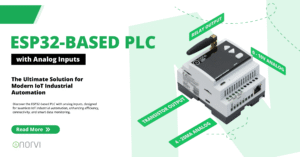
Norvi controllers excel in versatility, offering multiple I/O configurations to meet diverse application requirements. Panel Mount + Ethernet + RS-485 Digital Inputs + Analog Inputs + Transistor Outputs + Modbus Support PLC + HMI The range includes digital inputs, analog inputs supporting both 0-10V and 4-20mA standards, relay outputs, and transistor outputs for precise control applications.
NORVI’s tailored range of 0-10V and 4-20mA Analog Inputs presents customized solutions for industrial requirements. This flexibility ensures compatibility with virtually any sensor or actuator configuration, eliminating the need for additional interface modules.
Built-in IoT and Connectivity Solutions
What sets Norvi apart from traditional PLCs is their native IoT capabilities. The ESP32 stands tall as a robust and versatile microcontroller, boasting integrated Wi-Fi and Bluetooth functionalities that render it a prime choice for Internet of Things (IoT) applications. This integration enables seamless connectivity to cloud platforms, remote monitoring systems, and enterprise networks without additional hardware.
The controllers support multiple communication protocols including Ethernet, RS-485, Wi-Fi, and cellular options. This comprehensive connectivity suite positions Norvi devices at the forefront of Industry 4.0 implementations.
Programming Flexibility and Ease of Use
One of NORVI’s most significant advantages lies in programming accessibility. Supports Arduino IDE, ESP-IDF and more for programming. Tutorials and guide for getting started with the devices. Low-cost devices when compared with the PLC controllers which do the same job. This compatibility with popular development environments dramatically reduces the learning curve and development time.
The Arduino IDE support is particularly valuable for engineers familiar with this platform, enabling rapid prototyping and deployment. Additionally, support for professional development environments ensures scalability for complex applications.
Practical Implementation Strategies
Small to Medium-Scale Applications
For smaller automation projects, NORVI’s compact controllers offer exceptional value. With two transistor outputs, NORVI Cema offers PWM or pulse output capabilities, adding versatility to your industrial automation projects. These systems excel in applications such as building automation, small manufacturing cells, and testing equipment.
The built-in HMI capabilities eliminate the need for separate operator interfaces in many applications. Integrated OLED and buttons can be programmed as an HMI, enhancing user interaction and control within your industrial applications.
Industrial IoT and Remote Monitoring
For applications requiring extensive connectivity and data logging capabilities, NORVI’s IoT-enabled controllers provide comprehensive solutions. These devices come equipped with digital and analog I/O, enabling them to detect digital logic states and analog inputs, depending on the choice of the model. The built-in data logging capabilities, combined with microSD card support, enable local data storage and backup.
Scalability and Futureproofing
Ensure the chosen PLC can handle your application’s demands now and in the future. Look for a PLC that offers scalability Norvi addresses this critical requirement through modular expansion capabilities and comprehensive communication options that support system growth and integration with additional devices.
Cost-Benefit Analysis and ROI Considerations
Initial Investment Comparison
Norvi controllers offer significant cost advantages compared to traditional PLC systems. Low-cost devices when compared with the PLC controllers which do the same job. This cost efficiency doesn’t come at the expense of functionality or reliability, making them particularly attractive for budget-conscious projects.
Long-Term Operational Benefits
The true value of NORVI controllers emerges in long-term operation. Energy efficiency: Optimized control of machinery helps reduce energy consumption, lowering operational expenses and environmental impact. The combination of energy-efficient operation, reduced maintenance requirements, and comprehensive diagnostic capabilities contributes to substantial operational savings.
Maintenance and Support Considerations
NORVI”s approach to maintenance is revolutionary. The familiar programming environment and extensive documentation reduce training requirements and maintenance complexity. Remote diagnostic capabilities enable proactive maintenance strategies that minimize unplanned downtime.
Implementation Best Practices
System Planning and Design
Successful PLC implementation begins with thorough system analysis. Document all I/O requirements, communication needs, and performance specifications before making your selection. Choosing the right PLC involves balancing your application requirements, scalability needs, and budget.
Consider future expansion possibilities and ensure your chosen system can accommodate growth. NORVI”s modular approach and extensive I/O expansion capabilities provide excellent scalability options.
Installation and Configuration
Proper installation practices ensure optimal system performance. Follow industry standards for electrical installation, grounding, and cable routing. Norvi controllers’ industrial-grade construction and protection features provide excellent reliability when properly installed.
Testing and Validation
Comprehensive testing validates system functionality before full deployment. Utilize NORVI’s built-in diagnostic features and monitoring capabilities to verify proper operation across all system components.
Future Trends and Technology Integration
The industrial automation landscape continues evolving rapidly. Current approaches to manufacturing must evolve to respond to increasing demands for short product life cycles and customized products. NORVI controllers’ IoT-native architecture positions them advantageously for emerging trends including edge computing, artificial intelligence integration, and advanced analytics.
Machine learning capabilities, predictive maintenance algorithms, and advanced data analytics are becoming standard requirements. NORVI’s powerful processing capabilities and extensive connectivity options provide an excellent foundation for these advanced applications.
Conclusion
Selecting the optimal PLC for your automation project requires careful consideration of multiple factors including processing requirements, I/O configuration, communication needs, and long-term scalability. NORVI Industrial Controllers emerge as a compelling solution that addresses these requirements while providing exceptional value and innovative features.
The combination of industrial-grade reliability, comprehensive connectivity options, programming flexibility, and cost-effectiveness makes NORVI controllers an excellent choice for a wide range of automation applications. Whether you’re implementing a simple control system or a complex IoT-enabled manufacturing solution, NORVI’s diverse product range and advanced capabilities provide the foundation for successful automation projects.
By choosing NORVI Industrial Controllers, you’re not just selecting a PLC – you’re investing in a comprehensive automation platform that grows with your needs and positions your organization for future technological advances. The result is improved efficiency, enhanced productivity, and significant cost reduction that delivers measurable ROI from day one.
FAQs
NORVI controllers combine industrial-grade reliability with modern IoT capabilities, offering ESP32-based processing, built-in Wi-Fi/Bluetooth connectivity, and Arduino IDE compatibility at a fraction of traditional PLC costs.
Yes, NORVI controllers are specifically designed for industrial environments with features including optically isolated inputs, industrial-grade outputs, extended temperature ranges, and robust construction suitable for harsh conditions.
NORVI controllers support multiple programming environments including Arduino IDE, ESP-IDF, and various industrial automation platforms, providing flexibility for different skill levels and application requirements.
NORVI controllers feature built-in Wi-Fi, Bluetooth, and optional cellular connectivity, along with support for cloud platforms, MQTT, and standard industrial communication protocols like Modbus and Ethernet.
NORVI offers comprehensive I/O including digital inputs, analog inputs (0-10V and 4-20mA), relay outputs, transistor outputs, and PWM capabilities, with expansion modules available for larger systems.

 by
by