
Industrial communication protocols form the backbone of every modern automation system. When machines, sensors, and controllers need to exchange data reliably over long distances, engineers turn to proven standards — and few standards have stood the test of time as well as Modbus over RS-485. NORVI IIOT controllers come fully equipped with RS-485 connectivity and built-in Modbus driver support, making them ready to join any industrial network straight out of the box. In this guide, you will discover exactly how the NORVI IIOT operates as a Modbus device, what Modbus RTU and Modbus TCP mean in practice, and why this combination makes NORVI one of the most versatile industrial IoT controllers available today.
What Is RS-485 and Why Does Industrial Automation Rely on It?
RS-485 is a serial data transmission standard that engineers specifically designed for industrial environments. Unlike single-ended serial standards such as RS-232, RS-485 uses differential signalling — transmitting data as the voltage difference between two wires rather than as a voltage relative to ground. As a result, RS-485 achieves excellent noise immunity, making it the preferred choice for factory floors, process plants, and building automation systems where electrical interference is a constant challenge.
Furthermore, RS-485 supports multi-drop networks, meaning a single cable can connect multiple devices simultaneously. A standard RS-485 network supports up to 32 driver/receiver pairs on one bus segment, and with repeaters, engineers can extend this to hundreds of nodes. Additionally, RS-485 handles cable runs of up to 1,200 metres at lower data rates — a critical advantage in large industrial facilities where control rooms sit far from field devices.
Because of these properties, RS-485 has gained widespread recognition across dozens of automation systems worldwide. Today, it underpins building management systems, energy metering networks, motor drive communications, and industrial sensor buses — typically running the Modbus protocol on top.
Understanding the Modbus Protocol
Modbus is a serial communication protocol that engineers at Modicon developed in 1979 specifically for use with programmable logic controllers. Despite its age, Modbus remains one of the most widely deployed industrial communication protocols in the world. Its endurance comes from its simplicity, openness, and reliability — qualities that engineers continue to value in an era of complex industrial networks.
At its core, Modbus defines how devices exchange information over serial lines or networks. The protocol organises data into four register types that devices use to expose their inputs, outputs, and internal variables to other devices on the network. Consequently, any Modbus-capable master device can read sensor values, write setpoints, and control outputs on any Modbus slave device — regardless of manufacturer.
Modbus Data Register Types
- Coils (Read/Write): Single-bit output values that a master can both read and write — typically representing digital outputs such as relay states.
- Discrete Inputs (Read Only): Single-bit input values that a master can read but not write — typically representing digital input states from switches or sensors.
- Input Registers (Read Only): 16-bit registers holding measurement data such as analog sensor readings, temperatures, or flow rates.
- Holding Registers (Read/Write): 16-bit registers that a master can both read and write — used for setpoints, configuration values, and control parameters.
Because Modbus organises data this way, integrating a new device into an existing system requires only knowing its register map — the table of addresses that corresponds to each data point. Therefore, Modbus integration is straightforward and well-documented, even across devices from different manufacturers.
Modbus RTU vs Modbus TCP: What Is the Difference?
Modbus exists in several variants, but the two most important for industrial applications are Modbus RTU and Modbus TCP. Understanding the difference between them helps engineers choose the right approach for each application.
Modbus RTU
Modbus RTU is the original Modbus variant, designed for serial communication over RS-485 or RS-232 links. RTU stands for Remote Terminal Unit, and this version uses a compact binary encoding that maximises data efficiency on low-bandwidth serial links. Modbus RTU operates on a strict master/slave architecture — one master device initiates all communication, and slave devices respond only when addressed.
Furthermore, Modbus RTU excels at long-distance data transmission. Because it runs over RS-485, it maintains reliable communication over cable runs of hundreds of metres at data rates typically ranging from 9,600 to 115,200 baud. As a result, Modbus RTU remains the dominant choice for field-level industrial networks where devices are spread across large areas.
Modbus TCP
Modbus TCP is a newer variant that wraps Modbus messages inside standard TCP/IP packets for transmission over Ethernet networks. Rather than requiring a dedicated serial cable, Modbus TCP devices connect through standard network infrastructure — switches, routers, and existing LAN cabling. Consequently, Modbus TCP integrates naturally into modern plant networks and IT infrastructure.
Additionally, Modbus TCP offers significantly higher data rates than Modbus RTU. Ethernet networks typically operate at 100 Mbps or faster, compared to the kilobits-per-second rates of RS-485 serial links. Moreover, TCP/IP’s built-in error detection and correction mechanisms provide faster fault recovery than Modbus RTU’s CRC-based error checking. Therefore, Modbus TCP suits applications where speed, network integration, and remote access are priorities.
Which Modbus Variant Should You Use?
The choice between Modbus RTU and Modbus TCP depends on your application requirements. If your devices spread across a large physical area and connect via existing RS-485 wiring, Modbus RTU is the natural choice. However, if your system connects through Ethernet infrastructure and you need faster data exchange or remote access via IP networks, Modbus TCP delivers better performance. In many modern industrial systems, engineers use both — running Modbus RTU at the field level and converting to Modbus TCP at the control level using gateway devices.
How the Modbus Master/Slave Architecture Works
Modbus networks operate on a clearly defined master/slave (also called client/server in Modbus TCP) communication model. Understanding this architecture is essential for configuring any Modbus network, including one that uses NORVI IIOT controllers.
In a standard Modbus RTU network, one master device controls all communication. The master initiates every transaction by sending a request frame that specifies the target slave address, the function code (what action to perform), the register address, and any data. The addressed slave then processes the request and sends a response. No slave initiates communication independently — all data exchange flows through the master.
Each slave device in the network carries a unique address between 1 and 247. The master uses this address to direct requests to specific devices. As a result, a single RS-485 bus can serve up to 247 slave devices, all sharing the same two-wire cable. Furthermore, address 0 serves as a broadcast address — the master sends messages to address 0 when it wants all slaves to receive the same command simultaneously, though slaves do not respond to broadcast messages.
Modbus Function Codes
Modbus defines a set of standard function codes that specify the type of operation the master requests. The most commonly used function codes in industrial applications include:
- Function Code 01: Read Coils — reads the status of digital output coils.
- Function Code 02: Read Discrete Inputs — reads the state of digital input contacts.
- Function Code 03: Read Holding Registers — reads the value of read/write 16-bit registers.
- Function Code 04: Read Input Registers — reads the value of read-only 16-bit measurement registers.
- Function Code 05: Write Single Coil — forces a single digital output on or off.
- Function Code 06: Write Single Register — writes a value to a single holding register.
- Function Code 16: Write Multiple Registers — writes values to a block of holding registers in one transaction.
NORVI IIOT as a Modbus Device: Key Capabilities
NORVI IIOT controllers integrate RS-485 hardware and Modbus protocol support directly into their industrial-grade design. This combination means that NORVI controllers slot into existing Modbus networks without requiring additional interface hardware, protocol converters, or complex configuration procedures.
Because NORVI controllers run on the ESP32 microcontroller platform, they benefit from a rich ecosystem of Arduino-compatible Modbus libraries. Engineers program the controller using the Arduino IDE, selecting the appropriate Modbus library for their application — whether operating as a Modbus RTU slave on an RS-485 bus or as a Modbus TCP client/server on an Ethernet or Wi-Fi network.
Operating as a Modbus RTU Slave
In the most common industrial deployment, the NORVI IIOT operates as a Modbus RTU slave on an RS-485 network. In this configuration, a master device — such as a SCADA system, HMI, or PLC — polls the NORVI controller at regular intervals to read sensor data, digital input states, and analog measurements. Additionally, the master writes to holding registers or coils to control digital outputs and update setpoints on the NORVI controller.
Furthermore, the NORVI IIOT’s built-in Modbus drivers ensure that the controller is up and running within seconds of powering on. There is no complicated installation procedure or specialised training required. Engineers connect the RS-485 wiring, configure the slave address and baud rate in the firmware, and the controller immediately starts responding to master requests. Consequently, integration time is minimal, and engineers can focus on application logic rather than communication setup.
Operating as a Modbus RTU Master
Equally, engineers can configure the NORVI IIOT to operate as a Modbus RTU master. In this role, the NORVI controller initiates communication with downstream slave devices — reading data from remote sensors, energy meters, or variable frequency drives and processing it locally. This capability makes the NORVI IIOT an excellent edge controller and data aggregator for IIoT applications where the controller collects data from multiple field devices and forwards it to a cloud platform or SCADA system.
Modbus TCP over Wi-Fi and Ethernet
Beyond RS-485 Modbus RTU, NORVI IIOT controllers also support Modbus TCP through their built-in Wi-Fi connectivity. The NORVI ENET model additionally provides wired Ethernet connectivity for applications requiring more reliable network communication. As a result, NORVI controllers integrate seamlessly into modern IP-based industrial networks, enabling remote monitoring, cloud data forwarding, and integration with SCADA and MES systems over standard network infrastructure.
Practical Applications of NORVI IIOT as a Modbus Device
The combination of RS-485 hardware, Modbus protocol support, and ESP32-based IoT connectivity makes NORVI IIOT controllers exceptionally versatile. The following applications illustrate where this capability delivers the most value:
- SCADA Integration: NORVI controllers serve as Modbus slave devices that expose sensor readings, digital I/O states, and process variables to SCADA systems – enabling centralised monitoring and control without proprietary hardware.
- Energy Metering Networks: NORVI acts as a Modbus master, polling energy meters distributed across a facility and aggregating consumption data for cloud-based energy management platforms.
- Building Automation: NORVI controllers interface with Modbus-enabled HVAC units, variable air volume (VAV) controllers, and lighting systems as part of a building management system (BMS).
- Remote Pump and Motor Control: As a Modbus master, NORVI reads status data from variable frequency drives (VFDs) and writes speed setpoints – enabling remote motor control over RS-485.
- Industrial Sensor Networks: NORVI collects data from Modbus-enabled pressure transmitters, temperature sensors, and flow meters, forwarding aggregated data to cloud platforms via Wi-Fi or GSM.
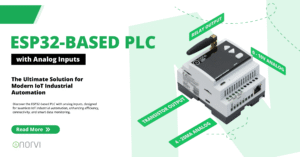
- PLC Integration: NORVI operates as a Modbus slave alongside traditional PLCs, extending the PLC’s I/O capabilities with additional analog inputs, digital outputs, and IoT connectivity.
Why NORVI IIOT Outperforms Traditional Modbus Devices
Traditional Modbus devices typically serve a single communication role – either as a fixed-function slave sensor or a dedicated master gateway. In contrast, NORVI IIOT controllers combine Modbus communication with full programmability, multiple connectivity options, and industrial-grade hardware in a single compact package.
Therefore, engineers deploy NORVI controllers where a traditional Modbus device would require supplementary hardware – a separate GSM modem for remote connectivity, a protocol converter for Modbus TCP bridging, or additional I/O modules for expanded sensor interfacing. Because NORVI integrates all of these capabilities natively, system complexity decreases and overall cost reduces significantly.
Moreover, NORVI’s lightweight design and DIN rail mounting make physical installation straightforward. Engineers complete the entire setup – wiring, addressing, and firmware upload – with just a few wire connections and a USB cable. Consequently, deployment time is dramatically shorter than traditional PLC or dedicated Modbus gateway installations.
Additionally, NORVI’s open-source Arduino programming environment means that engineers freely access a vast library of Modbus implementations, communication drivers, and IoT integration tools. As a result, development cost stays low and the pool of engineers who can work with NORVI hardware is large.
Conclusion: NORVI IIOT – The Smart Choice for Modbus-Enabled Industrial IoT
The NORVI IIOT controller brings together RS-485 hardware, Modbus RTU and TCP protocol support, and ESP32-based IoT connectivity in a single industrial-grade package. As a result, it serves equally well as a Modbus slave reporting to a SCADA master, a Modbus master aggregating field device data, or an IoT gateway bridging legacy serial networks to modern cloud platforms.
Furthermore, because NORVI uses open-source Arduino tooling and standard Modbus libraries, engineers integrate it quickly without expensive proprietary software or specialist training. The built-in Modbus drivers ensure the controller responds to network requests within seconds of powering on — making deployment fast and commissioning straightforward.
Whether you are building a new industrial monitoring system from scratch, extending the reach of an existing SCADA network, or upgrading legacy serial devices with cloud connectivity, the NORVI IIOT delivers the performance, flexibility, and reliability your application demands. Therefore, if Modbus communication is part of your industrial network architecture, NORVI IIOT belongs in your design.
Explore NORVI IIOT for Your Modbus Application
View the full NORVI IIOT product range at norvi.lk/norvi-iiot-industrial-esp32-for-iiot-applications. Browse compatible controllers and accessories at shop.norvi.lk, and access technical documentation including wiring guides and firmware examples at norvi.lk/docs. For project-specific enquiries, contact the NORVI team at norvi.lk/contact-us.

 by
by