
Industrial automation demands hardware that survives harsh environments, interfaces reliably with industrial sensors and actuators, and connects intelligently to modern IoT networks. NORVI IoT devices meet all three requirements in a single compact controller. Built around the powerful ESP32 microcontroller and designed to IEC industrial standards, NORVI controllers deliver the digital and analog I/O capabilities that automation engineers need — combined with the Wi-Fi, Bluetooth, and serial connectivity that IIoT applications demand. In this guide, you will discover exactly what makes NORVI the industrial-ready digital I/O controller of choice for automation and IoT applications.
What Is an Industrial-Ready Digital I/O Controller?
A digital I/O controller is an electronic device that reads digital input signals from sensors, switches, and field devices, and drives digital output signals to actuators, relays, and indicators. In industrial environments, however, a controller must do far more than simply switch signals on and off.
Industrial-ready digital I/O controllers handle the elevated voltages, noise immunity requirements, and current levels that factory environments demand. They support IEC-standard 24V DC signalling, provide electrical isolation between field wiring and internal electronics, and survive the temperature extremes, vibration, and electromagnetic interference that consumer-grade electronics cannot tolerate.
Furthermore, modern industrial controllers integrate communication protocols such as Modbus, MQTT, and OPC-UA, allowing them to exchange data with SCADA systems, cloud platforms, and edge computing infrastructure. As a result, they serve not only as local control devices but also as intelligent nodes in wider Industrial Internet of Things (IIoT) architectures. NORVI IoT devices deliver all of these capabilities in a purpose-built, DIN rail-mountable package.
ESP32 at the Core: Processing Power Meets Industrial Design
Every NORVI IoT device runs on the Espressif ESP32 microcontroller — one of the most capable and widely supported embedded processors available today. The ESP32 delivers a dual-core 240 MHz processor, built-in Wi-Fi and Bluetooth connectivity, extensive GPIO capabilities, and a rich ecosystem of Arduino-compatible libraries and community resources.
However, raw ESP32 development boards lack the industrial-grade hardware needed for factory deployment. NORVI solves this by integrating the ESP32 into a purpose-designed industrial controller that adds proper power supply regulation, isolated I/O interfaces, robust enclosures, and IEC-compliant signal conditioning. Consequently, engineers gain all the flexibility and connectivity of the ESP32 platform without compromising on the reliability that industrial applications require.
Moreover, because NORVI controllers program through the Arduino IDE, the learning curve is minimal. Engineers who already work with Arduino or ESP32 development can immediately apply their existing skills to NORVI hardware. Additionally, the vast Arduino library ecosystem means that integrating sensors, communication protocols, and cloud platforms requires only a few lines of code rather than complex proprietary programming.
Digital Inputs: Isolated, Safe, and Industrial-Grade
Digital inputs on NORVI IoT controllers read the state of field devices — detecting whether a switch is open or closed, whether a sensor has triggered, or whether a machine has reached a specific position. However, in industrial environments, the source of an input signal can pose a significant threat to the controller’s internal electronics.
Field wiring runs alongside power cables, motor drives, and other noise sources. Additionally, inductive loads such as motors and solenoids generate voltage spikes that can damage unprotected electronics. Furthermore, ground loops and differences in reference potential between devices create common-mode voltages that ordinary inputs cannot reject safely.
Optically Isolated Digital Inputs
NORVI addresses these risks by providing optically isolated digital inputs. Optical isolation uses a light-emitting diode (LED) and a photodetector separated by an air gap to transmit the signal state without any electrical connection between the field wiring and the controller’s internal circuitry. As a result, high-voltage transients, ground loops, and common-mode noise on the field side cannot damage or disrupt the controller’s internal electronics.
This isolation makes NORVI digital inputs safe to connect directly to 24V DC industrial sensors, proximity switches, limit switches, and pushbuttons — the standard field devices found throughout industrial automation systems. Therefore, engineers wire NORVI controllers directly into existing industrial panels without needing additional isolation hardware or signal conditioning modules.
Sinking and Sourcing Input Capability
NORVI industrial ESP32 IoT devices support both sinking and sourcing input configurations. This flexibility is essential because different industrial sensors and wiring conventions use different current flow directions. A sinking input (NPN configuration) accepts current flowing into the input terminal from the field device, while a sourcing input (PNP configuration) sources current out to the field device.
Because NORVI controllers support both configurations, engineers connect NPN and PNP sensors without needing separate input modules or re-wiring. Consequently, NORVI integrates seamlessly with the full range of industrial proximity sensors, photoelectric sensors, and push-pull output devices that automation systems use.
Analog Inputs: Measuring the Physical World at Industrial Level
Beyond digital state detection, many industrial applications require precise measurement of physical quantities — temperature, pressure, flow rate, level, and humidity. NORVI IoT devices include dedicated analog input channels that accept the standard industrial signal ranges used by field transmitters and transducers.
Voltage and Current Measurement
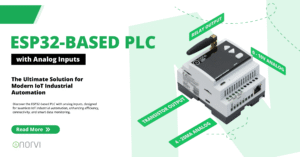
NORVI analog input models accept 0-10V and 4-20mA signals — the two most common industrial analog signal standards. The 4-20mA current loop is particularly important in industrial settings because current signals resist the effects of cable resistance and electrical noise far better than voltage signals. Furthermore, the 4mA live zero allows controllers to detect broken wire or sensor fault conditions, since a healthy sensor always outputs at least 4mA. As a result, 4-20mA inputs provide both measurement accuracy and diagnostic capability that voltage inputs alone cannot match.
Environmental Measurement: Temperature, Pressure, and Flow
Specific NORVI models extend analog capability to direct environmental measurement. These variants measure temperature using RTD and thermocouple sensors, pressure through dedicated transducer inputs, and flow rate via pulse or analog flow transmitter signals. Therefore, NORVI controllers serve not only as general-purpose I/O devices but also as specialised measurement instruments for process control applications.
Because these measurements integrate directly into the controller firmware, engineers implement complete closed-loop control applications — reading process variables, applying control logic, and driving outputs — without requiring separate transmitter modules or external signal converters.
Digital Outputs: Relay and Transistor Options Explained
NORVI IoT controllers offer digital outputs in two distinct technologies — relays and transistors. Each technology carries specific advantages and trade-offs, and understanding these differences helps engineers select the right output type for each application.
Relay Outputs
Relay outputs use an electromechanical switch — a coil that magnetically attracts a set of contacts — to switch the load. Relays provide complete electrical isolation between the controller circuit and the load circuit, and they switch both AC and DC loads across a wide voltage range. As a result, relay outputs suit applications where the load voltage differs from the controller supply voltage, or where switching AC mains circuits directly from the controller output is necessary.
However, relay outputs carry notable limitations. Switching speed is significantly slower than transistor outputs, typically limited to a few operations per second for reliable contact life. Furthermore, relays produce an audible click with each switching operation — a minor nuisance in quiet environments but a useful diagnostic indicator in panel installations. Additionally, relay coils consume more current than transistor driver circuits, contributing to higher power dissipation in dense I/O configurations.
Despite these limitations, relay outputs remain the most versatile digital output technology for general industrial use. Consequently, NORVI offers relay output variants for applications where load voltage flexibility and isolation are the primary requirements.
Transistor Outputs
Transistor outputs use solid-state switching — typically an NPN or PNP transistor or MOSFET — to control the load. Compared to relays, transistors switch far faster, operate silently, consume less power, and occupy a smaller physical footprint. Therefore, transistor outputs suit high-speed switching applications such as stepper motor pulse outputs, PWM-controlled loads, and fast-cycle solenoid valves.
Additionally, transistor outputs have no mechanical wear, giving them virtually unlimited electrical life compared to the rated contact life of electromechanical relays. As a result, applications requiring millions of switching cycles per day — conveyor control, packaging machinery, and high-frequency pulse outputs — benefit significantly from transistor output controllers.
Furthermore, transistor outputs are more affordable to manufacture than relay outputs, making NORVI transistor models a cost-effective choice for applications where AC load switching and contact isolation are not required. Both sinking (NPN) and sourcing (PNP) transistor output variants are available across the NORVI lineup to match the wiring conventions of different actuators and loads.
Simplified Wiring and Flexible Installation
One of the practical advantages that engineers immediately notice when deploying NORVI IoT controllers is the reduced wiring complexity compared to traditional PLC systems. NORVI devices require minimal wiring to achieve full functionality — power supply connections, field I/O wiring, and communication cables are all that the installation demands.
Furthermore, NORVI controllers mount on standard DIN rails using the same clips used throughout industrial control panels. This mounting system makes installation fast and ensures that NORVI integrates physically alongside existing terminal blocks, circuit breakers, and relay modules without requiring custom enclosure modifications.
Because the sinking and sourcing capabilities within NORVI industrial ESP32 IoT devices allow current to flow in either direction, engineers do not need to plan separate wiring looms for NPN and PNP devices. Instead, they configure the input mode in firmware and wire all field devices to the same terminal block. Consequently, panel wiring is neater, commissioning is faster, and future modifications are simpler to implement.
IIoT Connectivity: From the Factory Floor to the Cloud
Traditional digital I/O controllers stop at the panel door — they read inputs, drive outputs, and communicate with a local SCADA system over a serial bus. NORVI IoT controllers go further by integrating native Wi-Fi, Bluetooth, and optional GSM or Ethernet connectivity directly into the device. As a result, NORVI controllers actively participate in IIoT architectures, pushing data to cloud platforms, receiving remote commands, and enabling mobile monitoring dashboards without any additional hardware.
MQTT and Cloud Integration
NORVI controllers support the MQTT messaging protocol natively through Arduino-compatible libraries. MQTT is the lightweight publish-subscribe protocol that most IoT cloud platforms — including AWS IoT, Microsoft Azure IoT Hub, and Google Cloud IoT — use for device communication. Therefore, engineers configure NORVI controllers to publish sensor readings and I/O states to cloud dashboards, and subscribe to command topics that trigger digital outputs remotely.
Modbus and SCADA Integration
For integration with existing industrial systems, NORVI controllers communicate over Modbus RTU via the built-in RS-485 port or Modbus TCP via Wi-Fi and Ethernet. This allows NORVI to operate as a Modbus slave that exposes its I/O data to SCADA masters, HMI panels, and building management systems. Consequently, NORVI controllers slot into existing automation architectures without requiring system-wide modifications.
NORVI Product Lineup: Choosing the Right I/O Controller
NORVI offers a comprehensive lineup of industrial IoT controllers to match different I/O requirements and connectivity needs. The following models represent the key options available:
- NORVI IIOT: The core industrial ESP32 controller with digital inputs, digital outputs, analog I/O, and RS-485 Modbus support – the most versatile model for general automation and IIoT applications.
- NORVI ENET: Adds wired Ethernet connectivity to the NORVI IIOT feature set – ideal for applications requiring deterministic network communication in environments where Wi-Fi is unreliable.
- NORVI GSM: Integrates GSM/GPRS cellular connectivity for remote monitoring applications where wired or Wi-Fi networks are unavailable – water treatment plants, agricultural pumping stations, and remote energy meters.
- NORVI Arita / Cema: Arduino-compatible industrial controllers that bring the same industrial I/O capabilities to engineers who prefer the broader Arduino programming ecosystem.
- NORVI Agent 1 / Agent 2: Compact industrial IoT node devices designed for distributed sensor networks and edge data collection applications.
- Expansion Modules: Additional I/O expansion modules that extend the channel count of base NORVI controllers – allowing engineers to scale the I/O capacity as application requirements grow.
Real-World Applications of NORVI Digital I/O Controllers
The combination of industrial-grade I/O, ESP32 processing, and native IoT connectivity makes NORVI controllers applicable across a wide range of industries and use cases. The following examples illustrate where NORVI digital I/O controllers deliver the most value:
- Manufacturing Line Control: NORVI controllers read limit switches and proximity sensors on conveyor systems, control pneumatic solenoids and motor contactors through relay outputs, and report production data to cloud dashboards via MQTT.
- Water and Wastewater Management: NORVI monitors tank levels, controls pump relays, reads flow meters through analog inputs, and transmits operational data to remote SCADA systems over GSM or Ethernet connections.
- Agricultural Automation: NORVI controllers manage irrigation pump sequencing based on soil moisture sensor readings, control valve solenoids through transistor outputs, and push environmental data to cloud platforms for remote farm management.
- Building Energy Management: NORVI reads energy meter data through analog inputs, controls HVAC relay outputs based on occupancy and temperature sensor inputs, and reports consumption data to cloud-based energy management dashboards.
- Industrial Machine Monitoring: NORVI monitors machine run/stop status through digital inputs, tracks production counts through high-speed pulse inputs, and alerts maintenance teams via cloud notifications when fault conditions occur.
- Remote Infrastructure Monitoring: Using GSM-connected NORVI controllers, engineers monitor pump stations, telecommunications equipment, and utility infrastructure from central control rooms without site visits.
Conclusion: NORVI Delivers Industrial I/O Readiness Without Compromise
NORVI IoT devices represent a new generation of industrial digital I/O controllers — combining the proven reliability of IEC-standard industrial hardware with the flexibility, connectivity, and affordability of ESP32-based IoT technology. As a result, engineers no longer face a choice between industrial-grade reliability and modern IoT capability. NORVI delivers both in a single, compact, DIN rail-mountable package.
Furthermore, the optically isolated digital inputs, flexible sinking and sourcing capability, relay and transistor output options, and dedicated analog measurement channels ensure that NORVI controllers interface accurately and safely with the full range of industrial sensors, actuators, and field devices. Additionally, the minimal wiring requirements and Arduino-compatible programming environment reduce both installation time and development cost significantly.
Whether you are building a new industrial automation system, upgrading existing field devices with IIoT connectivity, or developing a specialised monitoring solution for a specific application, NORVI IoT controllers provide the performance, flexibility, and industrial readiness your project demands. Therefore, if you need a digital I/O controller that works as hard as your industrial application requires, NORVI is the platform to build on.
Explore NORVI Industrial I/O Controllers Today
Browse the complete NORVI product range at norvi.lk/products and find the right I/O controller for your application. Purchase directly at shop.norvi.lk and access full technical documentation, wiring diagrams, and firmware examples at norvi.lk/docs. Contact the NORVI engineering team at norvi.lk/contact-us for application-specific guidance.

 by
by